
Home » Treatment Programs » Suboxone Treatment Program in Wilmington, DE
Opioid addiction can make it feel like your life revolves around avoiding withdrawal, managing cravings, and trying to regain control. At Lotus Recovery Centers, our Suboxone Treatment Program in Wilmington, Delaware provides compassionate, evidence-based care designed to help you break that cycle and begin building a healthier future.
Our outpatient program combines Suboxone medication, individualized counseling, behavioral therapies, and ongoing recovery support to address both the physical and emotional aspects of opioid addiction. Rather than simply managing symptoms, we help you develop the skills, support system, and confidence needed for long-term recovery.
Whether you’re seeking treatment for the first time, returning to recovery after a relapse, or transitioning from a higher level of care, our experienced clinical team will create a personalized treatment plan based on your unique needs and recovery goals. We believe recovery should be accessible, compassionate, and built around the life you’re working to rebuild.
If you’re ready to take the next step, our team is here to answer your questions, verify your insurance benefits, and help you begin treatment with confidence.
Get expert care, reduce cravings, and begin recovery with a plan built for you.
Our Suboxone treatment program is a medication-assisted treatment (MAT) program for adults living with opioid use disorder in Wilmington, Delaware. It pairs Suboxone (buprenorphine and naloxone) with counseling and ongoing clinical support to reduce cravings and ease withdrawal so recovery becomes something you can manage alongside work, family, and daily life. We offer same-day appointments, and most major insurance plans, Medicaid, and Medicare are accepted. If you’re comparing outpatient medication options in Delaware, this page walks through how the program works, who it’s for, and how Suboxone fits within the wider range of MAT medications we provide.
Suboxone contains two medications that work together to support recovery:
Together, these medications allow you to stabilize physically without experiencing the intense highs and lows associated with opioid use.
At Lotus Recovery Centers, Suboxone is always provided under medical supervision as part of a comprehensive treatment program—not as a standalone medication. Along with medication management, you’ll receive individualized therapy, relapse prevention planning, case management, and ongoing support to help you build a strong foundation for lasting recovery.
Suboxone is also one of several medications used in Medication-Assisted Treatment (MAT). While Medication-Assisted Treatment provides the overall framework for combining medication with behavioral therapies, our Suboxone Treatment Program focuses specifically on individuals who may benefit from Suboxone as part of their personalized recovery plan. If another medication is more appropriate, our team will discuss all available treatment options with you.
Suboxone is one medication within a broader medication-assisted treatment (MAT) program — the clinical approach that combines FDA-approved medication with counseling to treat opioid use disorder. A MAT program isn’t defined by a single drug; it’s a framework, and Suboxone is one of the most widely used options within it because it both reduces cravings and lowers the risk of misuse.
When you start our Suboxone MAT program, our clinicians assess your history, current use, and goals before recommending a medication. For many people, Suboxone is the right fit. For others, methadone or naltrexone may suit their needs better — and because we deliver the full range of MAT medications under one program, you’re never locked into a single path. If your treatment needs change over time, we can adjust the medication without sending you elsewhere.
That flexibility is the point of a MAT program: matching the medication to the person, then supporting that choice with counseling and regular check-ins. Suboxone is where many of our patients begin, and it’s backed by the same whole-person care that runs through everything we do. To see how the medications compare, read on to the Suboxone vs. Methadone vs. Naltrexone section below.
A Suboxone treatment program can be an effective option for individuals living with opioid addiction who are ready to begin recovery with structured medical and clinical support. By helping reduce withdrawal symptoms and cravings, Suboxone allows many people to focus on healing while continuing to meet many of their daily responsibilities through outpatient care.
Our program may be appropriate for individuals who:
While Suboxone is highly effective for many individuals, it is not the right treatment for everyone. Factors such as your medical history, substance use history, current health, and recovery goals all play an important role in determining the most appropriate treatment approach.
At Lotus Recovery Centers, our clinical team completes a comprehensive assessment before recommending a treatment plan. If another medication or level of care would better support your recovery, we’ll help guide you toward the option that’s best suited to your needs.
Suboxone treatment offers several proven benefits for opioid recovery:
When combined with therapy and support, Suboxone can provide the stability needed to begin rebuilding your life.
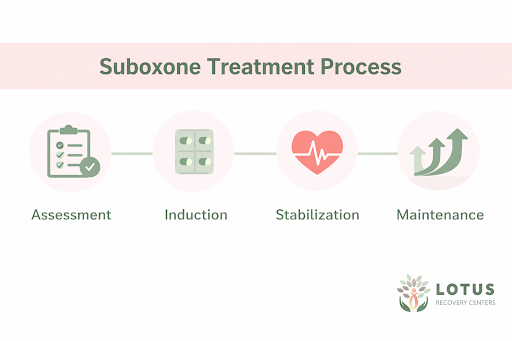
Every recovery journey is unique, but most individuals move through similar stages as they progress through a Suboxone treatment program. Our team provides guidance, medical oversight, and compassionate support at every step, helping you build confidence as you work toward lasting recovery.
Your journey begins with a confidential evaluation, where we’ll learn about your medical history, opioid use, recovery goals, and any co-occurring mental health concerns. This information allows us to create a personalized treatment plan that supports your unique needs.
Once treatment begins, your provider carefully introduces Suboxone while monitoring your response. The goal is to safely reduce withdrawal symptoms and cravings while helping your body adjust to the medication.
As your symptoms improve, your provider may adjust your medication to ensure it’s effectively supporting your recovery. During this phase, you’ll begin establishing healthy routines and actively participating in counseling and other recovery services.
Throughout treatment, you’ll continue attending follow-up appointments for medication management while participating in therapy, relapse prevention planning, and recovery-focused counseling. These services help you address the underlying causes of addiction and develop healthy coping strategies for long-term success.
Recovery is an ongoing process, not a single event. Whether your treatment involves shorter-term medication support or longer-term maintenance, our team will continue working with you to monitor your progress, celebrate milestones, and help you build a healthier, more fulfilling future.
There is no one-size-fits-all approach to treating opioid addiction. Several FDA-approved medications are available to support recovery, and the right option depends on factors such as your opioid use history, medical needs, lifestyle, and recovery goals.
At Lotus Recovery Centers, our clinical team will help determine which medication is most appropriate based on your individual circumstances. The goal is to recommend the treatment that offers the safest, most effective path toward long-term recovery.
Feature | Suboxone | Methadone | Naltrexone |
Helps reduce cravings | ✔ | ✔ | Limited |
Helps relieve withdrawal symptoms | ✔ | ✔ | ✘ |
Must complete detox first | ✘ | ✘ | ✔ |
Typically requires daily clinic visits | No | Often | No |
Can support outpatient treatment | ✔ | Sometimes | ✔ |
Best suited for | Mild to moderate opioid use disorder and many outpatient patients | Individuals with severe or long-term opioid dependence | Individuals who have already completed detox and want relapse prevention suppor |
Each medication has unique advantages, and what works well for one person may not be the best choice for another. During your assessment, our providers will review your health history, current opioid use, and recovery goals before recommending a personalized treatment plan.
If Suboxone isn’t the right fit, we may recommend another evidence-based medication as part of your recovery. Learn more about our Methadone Treatment Program or our broader Medication-Assisted Treatment (MAT) services to explore your options.
Choosing a Suboxone treatment program is about more than finding a provider who can prescribe medication—it’s about finding a team that will support your recovery every step of the way.
At Lotus Recovery Centers, we take a whole-person approach to opioid addiction treatment by combining medication management with counseling, behavioral therapies, and individualized recovery planning. Our goal is to help you achieve lasting stability while addressing the underlying challenges that contribute to substance use.
When you choose Lotus Recovery Centers, you’ll receive:
Choosing the right medication-assisted treatment depends on your needs, lifestyle, and recovery history.
Suboxone vs Methadone
Suboxone vs Naltrexone
Our team will guide you toward the option that best supports your long-term success.
Suboxone is considered a safe and effective treatment when used under medical supervision. However, like any medication, it may come with side effects.
Common side effects may include:
Suboxone has a lower risk of misuse compared to full opioids, but it should always be taken exactly as prescribed.
Our clinical team closely monitors your progress to ensure your treatment remains safe, effective, and aligned with your needs.
We’re here to support you through every step of recovery.
Recovery is about more than stopping opioid use—it’s about building a life that feels stable and meaningful.
Suboxone provides the physical stability needed to:
With the right support system in place, many individuals use Suboxone as a stepping stone toward long-term independence and recovery.
Concerns about cost should never prevent someone from seeking help for opioid addiction. At Lotus Recovery Centers, we work to make treatment as accessible as possible by accepting a variety of insurance plans and helping individuals understand their coverage before beginning care.
Depending on your plan, your insurance may cover services such as medication management, counseling, physician appointments, and other components of your Suboxone treatment program. Our admissions team can verify your benefits, explain your coverage, and answer questions about any potential out-of-pocket costs before treatment begins.
We proudly work with many insurance providers, including Medicaid, Medicare, and most major commercial insurance plans. If you’re unsure whether your insurance is accepted, we’ll help you review your options and determine the best path forward.
Seeking treatment is one of the most important investments you can make in your health and future. Our team is here to make the admissions process as simple and stress-free as possible so you can focus on what matters most—your recovery.
A Suboxone treatment program combines FDA-approved medication with counseling, behavioral therapy, and ongoing recovery support to help individuals overcome opioid addiction. At Lotus Recovery Centers, Suboxone is provided as part of a comprehensive outpatient program designed to address both the physical and emotional aspects of recovery.
Suboxone contains two medications: buprenorphine, which helps reduce opioid cravings and withdrawal symptoms, and naloxone, which helps discourage misuse. Together, they help stabilize the body so individuals can focus on counseling, recovery planning, and rebuilding their lives.
Yes. For many individuals with opioid use disorder, an outpatient Suboxone program can be highly effective when combined with therapy and ongoing clinical support. Medication helps manage cravings and withdrawal symptoms, while counseling addresses the behavioral and emotional factors that contribute to addiction.
Eligibility depends on your medical history, opioid use history, current health, and recovery goals. During your initial assessment, our clinical team will determine whether Suboxone is the most appropriate treatment option or if another medication or level of care would better meet your needs.
There is no standard timeline for treatment. Some individuals benefit from Suboxone for several months, while others may remain on medication longer. Your provider will regularly evaluate your progress and work with you to determine the treatment plan that best supports your long-term recovery.
In many cases, yes. Because our program is outpatient, many individuals are able to continue working, attending school, or caring for their families while participating in scheduled appointments, medication management, and counseling.
Many insurance plans provide coverage for Suboxone treatment, including Medicaid, Medicare, and numerous commercial insurance providers. Our admissions team can verify your benefits and explain your coverage before you begin treatment.
Both medications are effective treatments for opioid addiction, but they work differently and may be recommended for different individuals. Suboxone is commonly used in outpatient treatment and often provides greater flexibility, while Methadone may be more appropriate for individuals with more severe or long-term opioid dependence. During your assessment, our providers will recommend the medication that best aligns with your recovery needs.
Possibly. Some individuals transition to Suboxone after using another medication or completing detox. Because timing and medical history are important, our providers will evaluate your situation and develop a safe, personalized transition plan if appropriate.
Getting started is simple. Contact Lotus Recovery Centers to schedule a confidential assessment, verify your insurance benefits, and speak with a member of our admissions team. We’ll answer your questions, discuss your treatment options, and help you take the first step toward recovery.
Our team is available 24/7 to answer your questions, verify insurance, and help you begin Suboxone treatment today.