

You’ve kept it together. That’s the problem.
You show up at work. You juggle your family’s needs. You hit your deadlines, make the dinners, return the texts. And when things get too heavy, you pour another drink. Or take something small that helps you stay level. No one suspects anything because you’ve built your life around staying just functional enough.
But lately, something’s cracking.
You can feel it—your fuse is shorter, your sleep is worse, and you keep losing track of who you were pretending to be. There’s a whisper inside: “I can’t keep this up.” And maybe someone—a spouse, a therapist, a concerned friend—suggested something radical. An intensive outpatient program.
Here’s what most people won’t tell you: for high-functioning folks, IOP is often the hardest step of all. Not because it’s medically intense or emotionally chaotic, but because it breaks your favorite illusion: the one where you’re doing fine.
High-Functioning Addiction Is the Most Socially Accepted Kind
Let’s call it what it is. You don’t fit the stereotype of addiction. You haven’t lost your job. Your family isn’t falling apart. You’re not living out of your car or getting DUIs.
But that’s exactly why it’s so dangerous. High-functioning addiction is invisible—by design. You’ve built a life that lets you hide in plain sight. Maybe even from yourself.
And when you’re that good at hiding, asking for help feels like overreacting. Even selfish. But denial doesn’t always look like “I’m fine.” Sometimes it sounds like:
- “It’s not that bad.”
- “I can stop whenever I want—just not right now.”
- “I just need a break, not a program.”
We get it. We’ve heard it before. And we know how hard it is to step toward something that might expose what you’ve worked so hard to control.
Why IOP Feels Like a Threat to High-Functioning Lives
An intensive outpatient program (IOP) is designed to work with your life. You don’t have to move into a facility. You don’t have to hit pause on everything. But for someone who’s built an identity around performance and competence, even that feels like too much.
Because here’s what IOP asks of you:
- To be still.
You can’t outrun your thoughts in a three-hour group session. - To be honest.
Not just with others—but with yourself. - To be vulnerable.
In front of people. On purpose.
It feels like weakness. It feels like failure. But what if it’s not?
What if it’s the first real thing you’ve done for yourself in years?
You’re Not the First to Burn Out in Silence
We talk to high-functioning clients all the time who say some version of:
“I didn’t think I qualified for help.”
They were lawyers. Moms. Nurses. Small business owners. Teachers. Men who hadn’t missed a day of work in 15 years. Women who could run a PTA meeting and a household on four hours of sleep and vodka.
They didn’t feel “sick enough” for treatment. Until something snapped—or nearly did.
One former IOP client told us:
“I kept thinking, if I just had a little more willpower, I could fix this on my own. But I wasn’t getting better. I was getting quieter. Numb.”
IOP Isn’t Just for Rock Bottom
There’s a myth that you have to lose everything before you earn the right to recover. That’s garbage. Rock bottom is not a prerequisite for healing.
In fact, some of the most powerful recoveries we’ve seen come from people who stepped into IOP before the wheels came off.
Our intensive outpatient program is built for exactly that moment:
- When you’re still functioning—but not really living
- When your coping mechanisms have stopped working
- When you’re ready to stop almost falling apart every night
IOP gives you a place to slow down the unraveling and begin rebuilding without losing everything in the process.
The Real Withdrawal? Control, Not Just Substance
People expect withdrawal from alcohol or opioids. They don’t expect withdrawal from being the strong one.
If you’ve spent years being the helper, the achiever, the one who doesn’t need anything—IOP strips that armor. And that can feel brutal.
But it’s also where the real healing begins. Because for the first time, you get to be a person. Not a performance.
You don’t have to impress anyone in group. You just have to show up. And that’s harder—and braver—than hiding ever was.
What IOP Actually Looks Like (Spoiler: You’re Still You)
A lot of high-functioning folks imagine IOP will wreck their routines. That it’ll be too much. That they’ll be too exposed.
In reality, here’s what it often looks like at Lotus Recovery Centers:
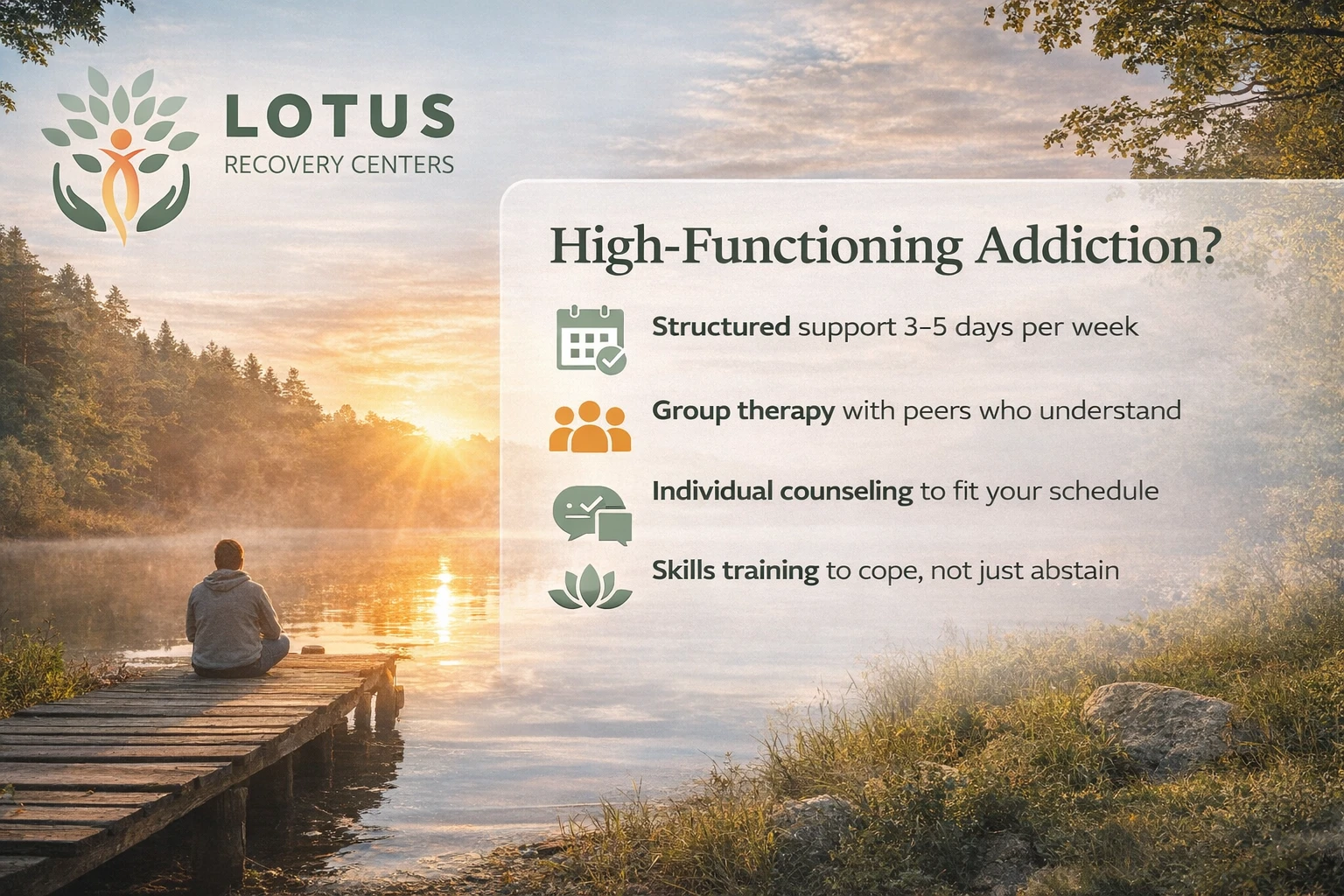
- Three to five days a week of structured support
- Group therapy sessions with others who get it
- Individual counseling that respects your pace and privacy
- Skills training for coping, not just abstaining
You don’t have to give up your identity. But you might get to find out who you are underneath the stress and self-medication.
If you’re nearby, you can also get this kind of care in Delaware without needing to leave your life behind.
The Hardest Step Is the One That Tells the Truth
Let’s be honest: IOP won’t fix everything.
But it will give you space to breathe. To stop pretending. To stop numbing just to keep functioning.
If you’re still reading this, there’s a reason. Maybe a part of you is already tired of managing the mask. Maybe a part of you is already asking for more.
And maybe, just maybe, it’s time to listen.
FAQs About Intensive Outpatient Programs (IOP)
What exactly is an intensive outpatient program?
An IOP is a structured form of addiction treatment that offers intensive therapy without requiring a residential stay. Clients attend multiple sessions per week—usually around 3 hours a day, several days a week—and return home afterward. It provides a strong level of support while allowing you to maintain your job, family life, and routines.
Is IOP right for me if I’m still working and taking care of things?
Absolutely. In fact, IOP is often especially effective for people who are still holding it together on the surface but know something isn’t right underneath. It meets you where you are—before things fall apart completely.
Will I have to talk in front of a group?
Group therapy is a part of IOP, yes—but you don’t have to spill your deepest secrets on day one. You’re allowed to take your time. Many clients find it incredibly relieving to hear others say the things they’ve never said out loud.
How do I know if I’m “bad enough” for IOP?
If you’re asking that question, you probably are. High-functioning people often wait too long because things haven’t “gotten bad enough.” IOP exists to help you before things break—when you’re ready to deal with the quiet pain, not just the chaos.
What makes Lotus Recovery’s IOP different?
We don’t believe in shame-based treatment. We meet you with respect, compassion, and a commitment to care that fits your real life. You’ll get professional support, peer understanding, and a clear path forward—without losing the parts of your life that matter to you.
You don’t need to prove you’re suffering to deserve help.
Call (833)922-1615 to learn more about our intensive outpatient program in Wilmington, DE.