

You don’t look like someone who needs help.
You’re the one people depend on. You keep the ship running — deadlines, meetings, pickups, paychecks. You make it to the gym (mostly), show up to social things (enough), and manage to look just tired enough that people don’t ask too many questions.
You’re functioning. Maybe even thriving. But underneath all that momentum, something’s shifting. Quietly.
You’ve noticed the dread that creeps in during the off-hours. The emptiness under the achievement. The substance that used to “take the edge off” now feels more like a requirement than a relief.
And you’ve started to wonder: If I’m still functioning, why do I feel like I’m coming apart?
Here’s what we want to say to you first — not as a diagnosis, but as a reality check:
A lot of high-functioning people end up in multi-day weekly treatment. Not because they “hit bottom.” But because they saw the bottom coming and chose not to wait.
This is what that moment looks like.
The Success Mask Doesn’t Let You Breathe
It’s easy to convince yourself you’re fine when everything still works.
You’re not missing work. You’re not forgetting your kid’s recital. You’re not crashing your car, going broke, or sobbing in public. You’re “handling it.”
But deep down, you know the effort it takes to keep the illusion intact. You’ve mastered a version of yourself that the world won’t question. And it’s killing you, slowly.
The wine glass that used to be optional is now how you end the day.
The anxiety that used to spike sometimes is now a low hum you can’t turn off.
The social mask is wearing thin — and you’re too good at faking it to be seen.
That’s the trap of high-functioning struggle. No one intervenes because you’re still ticking the boxes. But you know better.
“High-Functioning” Is Just Another Word for Hiding
Let’s be blunt: high-functioning doesn’t mean well. It means practiced.
People who stay busy, helpful, productive, and in control often have the hardest time admitting they’re hurting — because the mask works.
You don’t spiral. You spreadsheet.
You don’t break down. You double down.
You don’t disappear. You deliver.
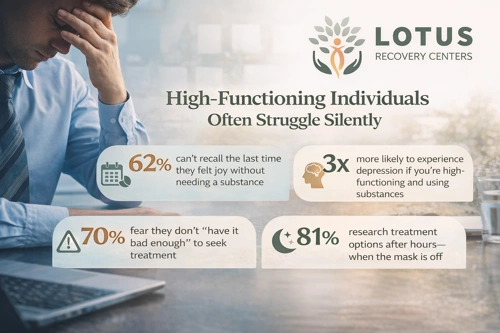
But when the silence gets loud, and the substance doesn’t take the edge off like it used to, and you start forgetting the last time you felt anything but drained — that’s when people like you quietly pick up the phone.
They don’t post a cry for help. They Google: “IOP near me.”
The Breaking Point Isn’t Always Loud
Most people imagine crisis as something cinematic — an intervention, a DUI, a public collapse.
But high-functioning people often slip into treatment with little fanfare. Their breaking point is internal. Invisible.
- It’s the realization that you can’t remember the last time you felt joy without needing something to spark it.
- It’s the moment you wake up and feel disappointed that you did.
- It’s when success stops feeling satisfying and starts feeling like a trap.
You don’t need to fall apart to decide you want something more than surviving.
You Don’t Have to Be “Worse” to Deserve Help
One of the biggest lies high-functioning people believe is this: “I’m not sick enough for treatment.”
That belief will keep you stuck longer than the drinking ever will.
The truth? You don’t need a diagnosis, a crisis, or a collapse to qualify for care. If you’re tired of white-knuckling your way through life, that’s enough.
Treatment isn’t just for people who’ve “lost everything.” It’s also for people who have everything and still feel hollow. For people who’ve made it — and now feel quietly trapped by what that means.
Real Support Doesn’t Ask You to Burn It All Down
Another thing high performers fear: that getting help will destroy their life as they know it.
That they’ll have to quit their job, tell their whole family, disappear from the world.
But that’s why structured, flexible care exists — so people like you can get help without detonating everything else.
Programs like ours are designed to fit into real life:
- Sessions in the morning, evening, or on weekends
- No overnight stays required
- Clear boundaries and professional support — no group-hug theatrics
You don’t have to leave your life to start changing it.
What Actually Brings High-Functioning People In?
It’s not always the substance.
It’s not always the depression.
It’s the slow erosion of your ability to feel connected — to yourself, to others, to anything real.
It’s waking up and feeling like you’re not in your own life anymore. Like you’re playing the role, checking the boxes, smiling through the fog.
It’s when you realize the things that used to light you up — career wins, family moments, creative pursuits — now feel distant and muted. And the only thing that still “works” is the drink. Or the pill. Or the numb.
That’s when people like you walk into a treatment center. Not with wreckage — but with a whisper:
“Something’s not right. And I don’t want to wait until it is.”
If You’re in Delaware, Help Isn’t Far
Lotus Recovery Centers offers accessible support in Delaware for people navigating high-functioning burnout, quiet addiction, or emotional detachment that won’t go away.
We work with professionals, parents, caregivers, and leaders — the people who usually carry the load and quietly break underneath it.
If you’re managing the outside but unraveling inside, you’re not alone. And you’re not past the point of change.
Frequently Asked Questions (FAQ)
Do I have to hit rock bottom to go to treatment?
No. And waiting for a collapse isn’t a requirement. Many people seek care long before their lives become unmanageable — because they’re emotionally worn out, disconnected, or using substances more than they want to admit.
Can I keep working while in treatment?
Absolutely. Our programs are structured to allow for flexible scheduling, with many clients balancing work or family commitments while attending sessions. It’s support built to fit real life.
What will people think if I go?
That’s up to you. You’re not obligated to tell anyone unless you choose to. And for those who do share, many are surprised by how much understanding and respect they receive — especially from others who’ve struggled in silence.
Isn’t treatment just for people who’ve lost everything?
No. That’s one of the most damaging myths out there. Treatment is for anyone who wants more than what they’re surviving right now. You don’t have to suffer publicly to qualify.
What if I don’t think I’m “that bad”?
If you’re asking the question, something’s not sitting right. You don’t need to be “that bad” to want to feel better. If you’re tired of the emotional weight, you’re allowed to set it down.
Call When You’re Ready — We’re Not Going Anywhere
High-functioning doesn’t mean free. It doesn’t mean well. It means you’ve learned how to survive in a way that looks impressive — and feels suffocating.
You don’t have to prove anything here. You don’t have to justify your pain or win your way into a care plan.
All you have to do is decide you’re tired of doing it alone.
Call 833-922-1615 or visit our multi-day weekly treatment options to learn more.
You’re not too far gone. You’re just done pretending it doesn’t hurt. Let’s start there.