

You did the right things.
You supported treatment.
You adjusted expectations.
You tried not to hope too hard—and hoped anyway.
And then it happened again.
Your child relapsed. Maybe it was subtle at first. A phone call that felt distant. Missed appointments. Money disappearing. And then suddenly, it was all too familiar: the lying, the withdrawal, the fear in your own chest.
This isn’t your first time through the cycle. And that makes it harder, not easier.
You might be wondering:
- Is this all treatment can do?
- Are we running out of options?
- How many times do we try before we accept that this just isn’t going to work?
If these thoughts feel heavy, you’re not alone—and you’re not failing.
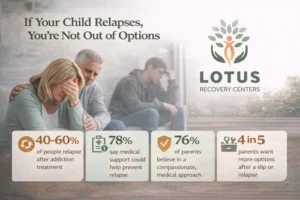
Relapse after treatment is heartbreaking. It can feel like proof that nothing works. But in many cases, what’s missing isn’t the will to change—it’s the right kind of support to make change last.
At Lotus Recovery Centers, we often meet families at this exact point—burned out, skeptical, and still fiercely protective of their child. We don’t promise quick fixes. But we do offer an approach that many people don’t encounter in their early rounds of care: medical stabilization paired with flexible therapeutic support.
If you’re looking for a different kind of path—one that meets your child’s biology as well as their behavior—you’re in the right place.
The Brain Doesn’t Rewire Just Because They Want It To
This is the part people don’t always talk about:
Your child may genuinely want to get better. They may mean it when they say they’re done. But once the brain has been changed by addiction, “wanting to change” and “being able to change” aren’t the same thing.
Repeated use alters core reward pathways, impulse control, and emotional regulation. That’s not a character flaw—it’s a medical reality. And it’s why relapse is so common after detox-only programs or short-term rehab stays that focus mostly on behavior.
Unless the neurology is supported, behavior will keep reverting under stress, triggers, or cravings—no matter how much your child swears they’re “serious this time.”
Medication Can Be the Missing Link
If you’ve tried residential treatment, therapy, detox, outpatient groups—or all of them—it’s easy to assume that adding medication into the mix sounds like just one more tool in an overcrowded toolbox.
But here’s the difference:
Medication doesn’t replace therapy. It makes it more effective. It calms the part of the brain that screams for relief. It reduces the intensity of cravings that sabotage progress. It quiets the emotional spikes that drive impulsive use.
In other words: it gives your child a fair chance to stay in the fight.
We’ve seen clients who couldn’t stay sober for more than a week without spiraling finally gain six, nine, twelve months of stability—not because they suddenly got stronger, but because their brain finally got the support it needed to stop sprinting toward escape.
You Are Not Enabling by Wanting Something Better
We know what you’re told.
“Tough love.”
“They have to want it.”
“Stop rescuing.”
But here’s something else:
You’re allowed to keep advocating for a different kind of help—even if your child has “already had their chances.”
Supporting a new approach—one that includes medical intervention and emotional flexibility—isn’t enabling. It’s evolving.
And if you’re afraid that encouraging medication is the same as “trading one drug for another,” you’re not alone. That concern is common, and we’ll address it more below. But know this: when prescribed and monitored appropriately, medication isn’t a replacement addiction. It’s a stabilizer. A stepping stone. A way to lower the volume of survival mode so your child can actually engage in their life again.
They’re Not Starting Over. They’re Starting From Experience.
It might feel like you’re back at square one. Again.
But the truth is, your child isn’t starting from nothing. They’ve been through this before. They’ve learned things, even if it didn’t “stick.” And you’ve learned things, too.
That knowledge matters. It means the next round doesn’t have to be a repeat—it can be a rebuild.
When we work with clients who’ve had multiple failed treatment attempts, we don’t throw out the past. We study it.
What worked for a while?
What collapsed under pressure?
What are they afraid to ask for now because they don’t want to let you down again?
This kind of reflective, adaptive care is hard to find. But it exists. And when paired with the right clinical tools, it often leads to something that finally feels sustainable.
You’re Not Weak for Feeling Tired
If you’re reading this and thinking, I don’t know how much longer I can do this—that doesn’t mean you’re giving up.
It means you’re human.
Loving someone through addiction is brutal. It’s repetitive. It’s thankless. And when you’ve already watched your child try and fall, try and fall—it’s natural to guard your heart and question everything.
But being tired doesn’t mean you’re done.
Sometimes, the most powerful thing a parent can do is shift from rescuing to reframing. To say:
“We haven’t failed. We’ve been missing a piece. Let’s try again, differently.”
That one sentence can re-open doors your child thought were closed.
If You’re in Delaware, You’re Closer Than You Think
Whether you’re local or exploring out-of-state care with a different approach, we offer trauma-informed, flexible care in Delaware for people who are tired of the cycle—but not ready to give up.
Our programs are built for re-entry, not judgment. We treat people who’ve relapsed, walked out, ghosted their counselors, and broken every promise they made to their family—only to find that something finally worked when medication, therapy, and empathy aligned.
If you’re looking for something with heart and science, we’re here.
Frequently Asked Questions (FAQ)
Haven’t we already tried everything?
Not necessarily. Most families cycle through programs that offer similar structures but miss the biological piece. Medication plus therapy is a different kind of foundation, not just another version of rehab.
Is this just another crutch?
No. Medications used in recovery (like buprenorphine or naltrexone) are not meant to replace substances. They’re medically monitored tools that support the brain’s ability to regulate, reducing relapse risk while other emotional work takes place.
Won’t they just misuse the medication?
That’s a fair concern. We use tightly structured protocols, medical supervision, and client education to reduce this risk. Most misuse happens when people are desperate. When treatment includes the right support, misuse goes down significantly.
Do they have to be fully sober first?
Not always. While detox may be required in some cases, we can often begin stabilizing care even if your child is actively using. Our admissions team can help assess readiness and recommend a safe starting point.
What if they’re not willing right now?
Start with information. You can call us yourself. We often help families prepare for conversations or interventions. Change doesn’t always begin with willingness. Sometimes it begins with just enough hope to take a first step.
You’re Not Out of Options. You’re Just Ready for Better Ones.
You’ve seen what doesn’t work. That makes you smarter—not cynical.
You’ve stayed, even when the system made you feel powerless. That makes you strong—even if you’re tired.
And your child? They are not a lost cause. They are a person who still needs what they may not know how to ask for: a care plan that matches the complexity of their pain.
Call 833-922-1615 to learn more about our medication-assisted treatment services in Delaware.
Let’s stop starting over. Let’s start wiser.