

Some people delay treatment because they don’t think they’re struggling badly enough.
Creative people often delay treatment because they’re afraid they’ll stop feeling like themselves.
That fear is rarely shallow. It’s deeply personal.
We hear it from musicians who worry they won’t connect to music the same way sober. Writers who fear they’ll lose emotional access. Artists afraid medication will flatten their imagination. Performers terrified they’ll become dull, disconnected, or emotionally muted.
A lot of people searching for help are not trying to hold onto addiction.
They’re trying to hold onto identity.
At Lotus Recovery Centers’ medication-assisted treatment programs, we talk to people every day who are exhausted by substance use but still terrified of what recovery might change. Not because they romanticize pain, but because pain, creativity, intensity, and survival have often become tangled together over many years.
That emotional knot can make asking for help feel incredibly complicated.
Creative Minds Often Experience the World Differently
Creative people tend to feel things intensely.
Not always dramatically. Sometimes quietly.
Many people who struggle with substance use are deeply observant. Sensitive to criticism. Hyperaware of emotion. Constantly thinking. Constantly noticing. Carrying conversations, memories, insecurities, ideas, and emotions all at once.
That intensity can be beautiful.
It can also become exhausting.
For some people, substances initially feel less like escape and more like relief:
- Relief from overthinking
- Relief from anxiety
- Relief from emotional heaviness
- Relief from loneliness
- Relief from self-consciousness
- Relief from never being able to fully turn the brain off
At first, substances can even appear helpful creatively. They may lower inhibition, create emotional openness, or temporarily quiet inner criticism.
That’s why many people develop a complicated emotional attachment to using.
Because eventually the substance stops feeling like a bad habit and starts feeling like part of the creative process itself.
The Fear Usually Sounds Like “What If I Lose Myself?”
This is the part many people don’t say out loud.
The fear is not always:
- “What if treatment doesn’t work?”
- “What if recovery is hard?”
- “What if people judge me?”
Often the fear is quieter and more vulnerable:
“What if I become someone I don’t recognize?”
Creative people frequently associate emotional intensity with authenticity. If substances became part of how they access emotion, connection, confidence, performance, or inspiration, the idea of removing them can feel terrifying.
We’ve worked with people who believed:
- Their best work only happened while using
- Their personality depended on substances
- Their social confidence would disappear sober
- They would lose emotional depth
- They would stop feeling creative entirely
- Their art would become empty
That fear deserves compassion.
Because underneath it is often someone trying desperately to protect the parts of themselves that matter most.
Addiction Slowly Starts Taking More Than It Gives
One of the hardest realities creative people face is realizing substances eventually stop enhancing life and start consuming it.
At first, there may genuinely feel like there’s a connection between creativity and substance use.
But over time, many people notice the shift.
The same thing that once felt inspiring begins creating:
- Emotional instability
- Panic attacks
- Isolation
- Depression
- Missed opportunities
- Relationship damage
- Physical exhaustion
- Creative inconsistency
- Shame and secrecy
People often spend more time recovering from substances than actually creating anything meaningful.
One client once told me:
“I thought substances were helping me access myself creatively. Eventually I realized they were slowly making my world smaller.”
That sentence stays with people because many understand it immediately.
Addiction narrows life over time.
Not all at once. Quietly.
Your routines shrink. Your energy shrinks. Your relationships shrink. Your emotional range becomes chemically managed instead of genuinely experienced.
And many creative people continue using long after it stops helping because they’re terrified sobriety will erase whatever remains.
The Myth of the “Tortured Creative” Keeps People Sick
Creative culture often romanticizes suffering.
Movies celebrate self-destructive artists. Music scenes normalize heavy substance use. Emotional chaos becomes framed as depth. Addiction gets mistaken for authenticity.
But there’s a difference between emotional depth and emotional survival.
And many people don’t realize how much addiction is hurting their creativity until they experience life without constantly managing withdrawal, shame, exhaustion, or emotional instability.
A nervous system trapped in survival mode cannot create freely forever.
Eventually it burns out.
That burnout may look like:
- Losing motivation
- Starting projects but never finishing them
- Emotional numbness
- Increased isolation
- Feeling disconnected from art itself
- Creating less while using more
- Feeling afraid of silence or sobriety
Many people quietly reach a point where substances are no longer expanding creativity.
They’re replacing it.
Medication-Assisted Recovery Is More Human Than People Expect
Medication-assisted recovery carries a lot of stigma, especially among people who fear losing emotional depth or identity.
Some people imagine medication will make them robotic, emotionally flat, or disconnected from themselves. Others fear they’ll become dependent on treatment forever. Many have heard harsh opinions online that make them ashamed for even considering help.
But reality is far more nuanced than stigma.
For many people, medication-supported treatment creates enough stability for the brain and nervous system to finally stop living in constant survival mode.
And survival mode is exhausting.
People often describe finally feeling:
- Clearer mentally
- Less emotionally chaotic
- More physically stable
- Less consumed by cravings
- More present in relationships
- Able to focus creatively again
The goal is not emotional numbness.
The goal is creating enough safety and stability for real healing to begin.
And importantly, good treatment should never try to erase personality.
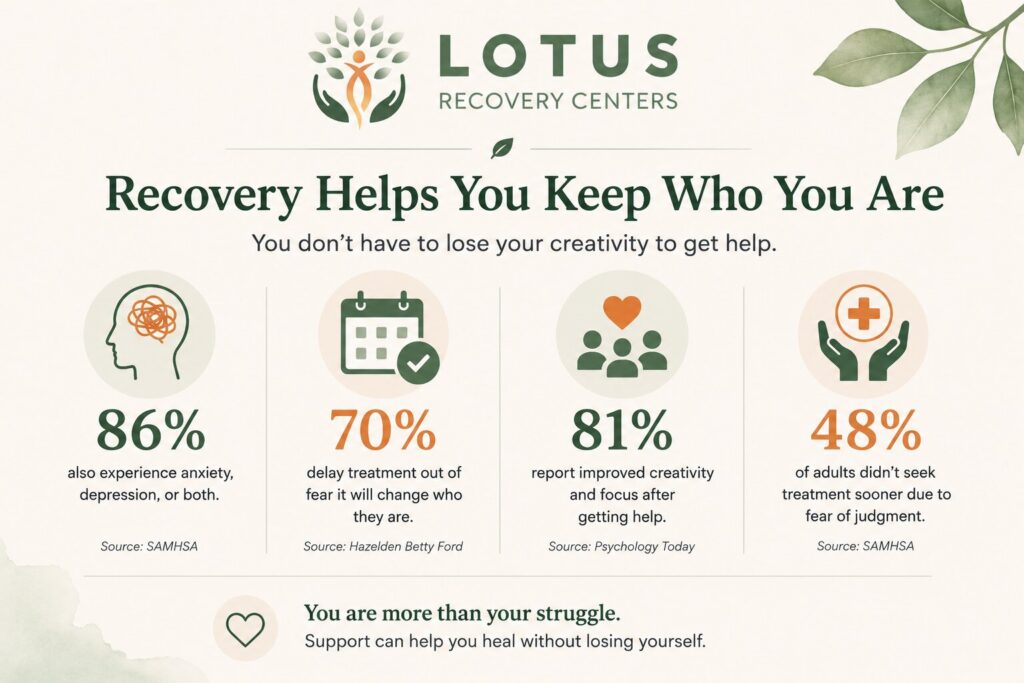
Recovery Is Not About Becoming Less Intense
This matters deeply for creative people.
Recovery is not about becoming bland, emotionally flat, or disconnected from your humanity.
In fact, many people rediscover themselves more honestly once substances stop controlling the nervous system.
That includes rediscovering:
- Creativity
- Curiosity
- Emotional connection
- Humor
- Sexuality
- Passion
- Authenticity
- Spirituality
- Presence
Substances often convince people they are protecting these qualities when, over time, they may actually be burying them underneath dependency and exhaustion.
One of the most painful parts of addiction is how gradually it replaces genuine emotional experiences with chemical ones.
People stop trusting their own emotions without substances involved.
That can make early recovery feel vulnerable and unfamiliar.
But unfamiliar does not mean empty.
Many Creative People Delay Help Until Things Become Dangerous
This is where things can become heartbreaking.
People wait because they believe they still have time. Because they’re still functioning. Because they’re still creating. Because part of them hopes things will somehow stabilize on their own.
Meanwhile, risk quietly increases.
We’ve seen people delay care after:
- Overdoses
- Dangerous withdrawal symptoms
- Severe depression
- Suicidal thoughts
- Panic attacks
- Career collapse
- Financial instability
- Relationship breakdowns
Not because they didn’t care about themselves.
Because they were afraid treatment would take away the parts of them they valued most.
That fear is understandable.
But addiction often takes far more identity away than recovery ever will.
You Do Not Need to Be Fully Ready to Ask Questions
A lot of people think they need certainty before reaching out.
They don’t.
Sometimes readiness looks like:
- Reading blogs like this late at night
- Wondering whether medication could help
- Feeling emotionally exhausted
- Secretly worrying about overdose or dependence
- Realizing substances no longer feel freeing
- Admitting life feels unsustainable
That counts.
For individuals searching terms like Suboxone doctors Wilmington Medicaid options, the deeper search is often emotional.
People are really asking:
- “Can I survive this?”
- “Can I still be creative?”
- “Will treatment erase me?”
- “Can I feel like myself again?”
Those questions deserve gentleness.
Not judgment.
Recovery Often Gives People Back More Than They Expected
One of the most surprising things many clients discover is that recovery does not erase emotion.
It often returns access to it.
Not the chemically amplified version. The real version.
People begin sleeping again. Feeling connected again. Creating again. Laughing without substances again. Experiencing relationships without emotional fog or panic underneath everything.
That process takes time.
But many eventually realize the version of themselves they were trying so hard to protect had already started disappearing underneath addiction long before they sought help.
Recovery is not about becoming somebody else.
It’s about no longer abandoning yourself to survive.
For people looking for help in Delaware, compassionate medication-assisted recovery options can create space for healing while still honoring your identity, creativity, and emotional depth.
Frequently Asked Questions
Will medication-assisted treatment make me emotionally numb?
Not necessarily. Many people actually feel more emotionally stable and mentally clear once treatment begins. The goal is not to erase emotion but to reduce the chaos, cravings, and instability that addiction creates.
Can creative people still feel inspired in recovery?
Yes. Many artists, musicians, writers, and creative professionals continue creating meaningful work in recovery. Some discover they are able to focus more clearly and create more consistently without substances dominating their lives.
Why do creative people often avoid treatment?
Creative people may fear losing emotional depth, personality, confidence, or artistic identity. Some also associate substances with inspiration, connection, or emotional access.
Is medication-assisted recovery only for severe addiction?
No. Medication-supported care can help individuals struggling with opioid dependence at many different stages. Treatment plans are individualized based on each person’s needs and circumstances.
What if I’m scared treatment will change who I am?
That fear is extremely common. But many people eventually realize addiction was already changing them in painful ways — emotionally, physically, creatively, and relationally. Recovery often helps people reconnect with themselves more honestly.
Can Medicaid help cover treatment services?
Coverage varies depending on eligibility and provider participation. Individuals searching for Suboxone doctors Wilmington Medicaid resources may benefit from speaking directly with a treatment provider to discuss options and next steps.
Call (833)922-1615 or visit the Lotus Recovery Centers medication-assisted treatment program to learn more about our programs, medication assisted treatment mat services in Delaware.