

When your child relapses, your whole body tightens. You don’t sleep. You scan their texts for signs of life. Every phone call feels like it could be the phone call.
And then someone—maybe a therapist, a case manager, or even your child—mentions medication-assisted treatment. And your gut tightens again.
“Wait. Isn’t that just replacing one drug with another?”
“I don’t want my kid dependent on anything else.”
“I want real recovery. Not a crutch.”
As a clinician, I’ve heard it hundreds of times. And every time, I listen first. Because that reaction? It’s not ignorance or judgment. It’s grief.
And underneath that grief is love.
If this is you—if your son or daughter is 19, 20, 22, and using again after treatment—you’re not wrong to be afraid. But let’s walk through this together. Because MAT might not be what you think it is, and it might just be the lifeline that helps your child live long enough to heal.
Learn more about our approach to Medication-assisted treatment at Lotus Recovery Centers.
You’re Not a Bad Parent for Questioning Medication
Let’s start here: You are not wrong for asking questions.
Many parents are handed a brochure or a prescription with little context. Of course you want to understand what your child is being given—and what the long-term plan is.
What I’ve learned after years in the field is this: the parents who ask, who wrestle with these decisions, who feel torn between hope and fear—those are the ones still trying. Still loving. Still showing up.
So let me say this as clearly as I can: letting your child access MAT is not giving up. It’s giving them another shot at staying alive.
MAT Isn’t Trading One Drug for Another
This is the core misunderstanding. And it’s completely fair to ask about.
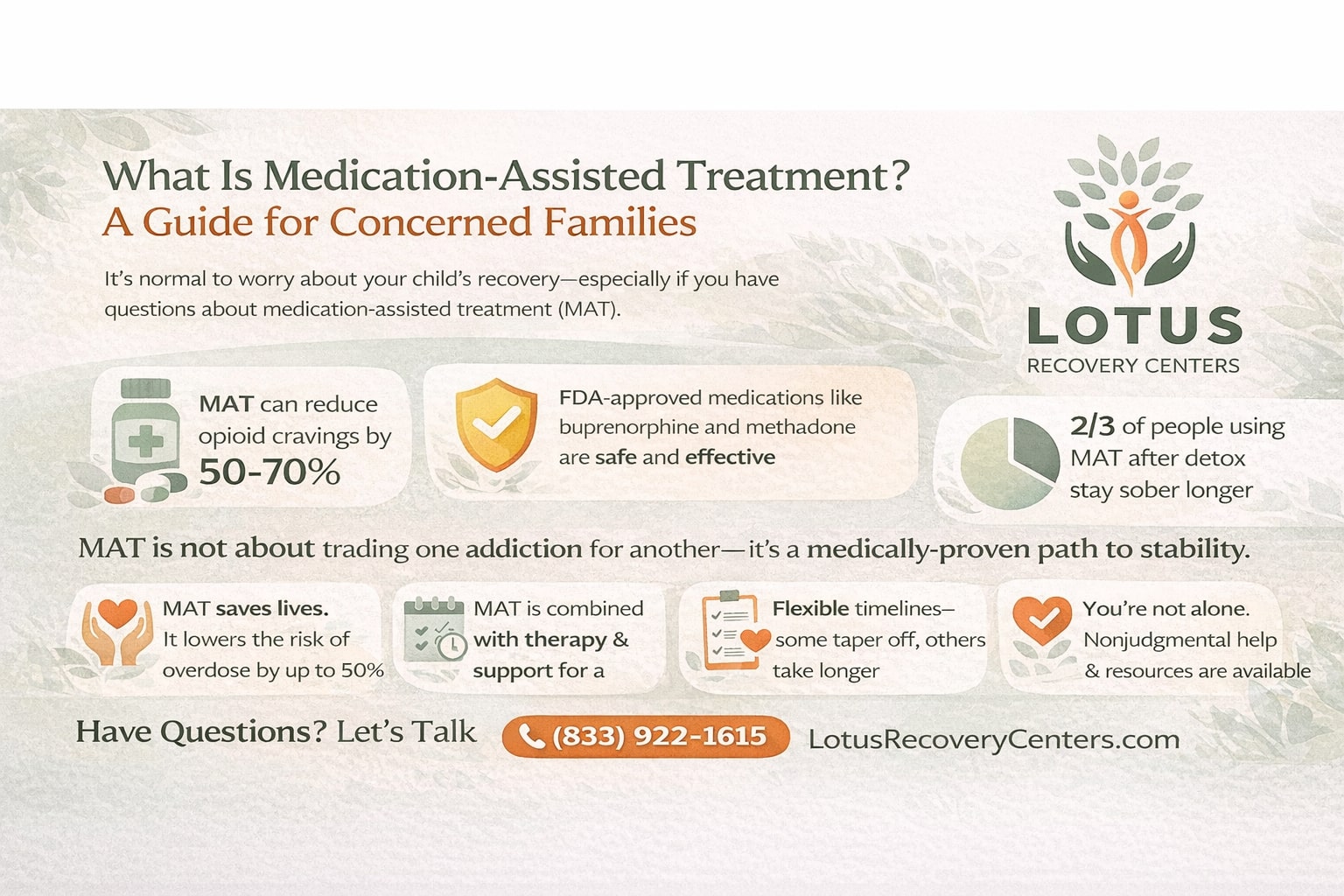
Medication-assisted treatment (MAT) refers to the use of FDA-approved medications—like buprenorphine (Suboxone), methadone, or naltrexone (Vivitrol)—combined with counseling and support to treat substance use disorders. These medications aren’t meant to create a high. They’re designed to stabilize.
For someone with opioid addiction, MAT can:
- Reduce intense cravings
- Block the effects of other opioids
- Decrease the risk of overdose
- Increase engagement in therapy and life stability
It’s not a “new addiction.” It’s a medical response to a complex brain illness. One that keeps people breathing, connected, and capable of rebuilding their lives.
“But I Want Them Totally Clean”
This is one of the hardest statements we hear from parents—and it’s also the most human.
You want your child back. Their smile, their spark, their confidence. You don’t want them to rely on anything external. You want full healing.
We do too.
But addiction rewires the brain. It hijacks reward pathways, reshapes risk tolerance, and changes how people experience fear, comfort, and motivation.
Expecting someone in early recovery to go without support—after multiple relapses—is like expecting a broken leg to heal while running a marathon.
Abstinence might still be the destination. But MAT can be the bridge. A long, steady one that holds when nothing else does.
Dependency Isn’t the Same as Addiction
This distinction matters.
Dependency means the body has adapted to a substance. That’s true of many medications—antidepressants, insulin, even blood pressure meds.
Addiction is about compulsion, loss of control, and continued use despite harm.
With MAT, your child may become physically dependent. But with medical supervision and support, that dependence is managed—not destructive. It’s a tool, not a trap.
What’s the Alternative Risk?
This is where the conversation gets real. Because the alternative isn’t just “trying harder” or going cold turkey. The alternative, too often, is fatal.
Fentanyl is in everything now—pressed pills, powders, even counterfeit Adderall. A single relapse can be a last relapse.
I’ve sat with families who were hesitant about MAT and later sat in rooms draped in black ribbons. This isn’t to scare you. It’s to say: this is how serious the landscape is now.
Medication-assisted treatment may feel like a compromise. But it’s often a life-saving one.
MAT Can Be a Stepping Stone—Not a Sentence
Some people stay on MAT for life. Others taper off gradually. It’s not a one-size-fits-all plan.
At Lotus Recovery Centers, we believe in individualized timelines, not pressure to “graduate” too soon. When someone is ready, there are safe ways to reduce dosage. But we never rush it. The goal is stability, not speed.
And if you’re unsure whether your child needs a full MAT program, or what their options are locally, you can always explore available support in Delaware.
You Deserve Real Conversations, Not Shame
Let’s be honest: addiction already comes with too much silence, too much stigma. The last thing you need is a treatment plan that feels like a lecture.
At Lotus, we walk families through the options—with honesty, transparency, and care. We explain the risks, the benefits, the logistics, and the long-term outlook. You are not just a signature on a form. You’re part of the support system.
FAQ: Medication-Assisted Treatment for Parents
What is MAT and how does it work?
Medication-assisted treatment (MAT) combines medications like buprenorphine or methadone with therapy and support. These medications reduce cravings, block highs, and allow the brain to stabilize so your child can engage in long-term recovery.
Isn’t MAT just replacing one addiction with another?
No. The medications used in MAT are carefully regulated, non-intoxicating at therapeutic doses, and don’t produce the same harmful cycles of use, crash, and compulsion. It’s more accurate to think of them like any other long-term medical treatment.
How long will my child need to be on MAT?
It depends. Some stay on for months, others for years. What matters is safety and stability—not rushing to get off the medication. At Lotus, we tailor the approach to each person’s needs.
Will my child still get therapy with MAT?
Absolutely. MAT is most effective when combined with counseling, peer support, and behavioral health services. It’s not just about medication—it’s a whole-person plan.
Is MAT covered by insurance?
Most insurance plans, including Medicaid, cover MAT services. We help families understand coverage and offer affordable options when needed.
📞 Ready to talk through your concerns?
You don’t have to decide alone. Call (833) 922-1615 or visit our Medication-assisted Treatment services page to explore your options. We’re here to help you and your child find safety, stability, and real recovery.