

You’re not just weighing a decision about change.
You’re protecting something that feels essential to who you are.
And that makes this harder than most people understand.
The Part of You You’re Afraid to Lose
For a lot of people, this isn’t about substances.
It’s about identity.
It’s about:
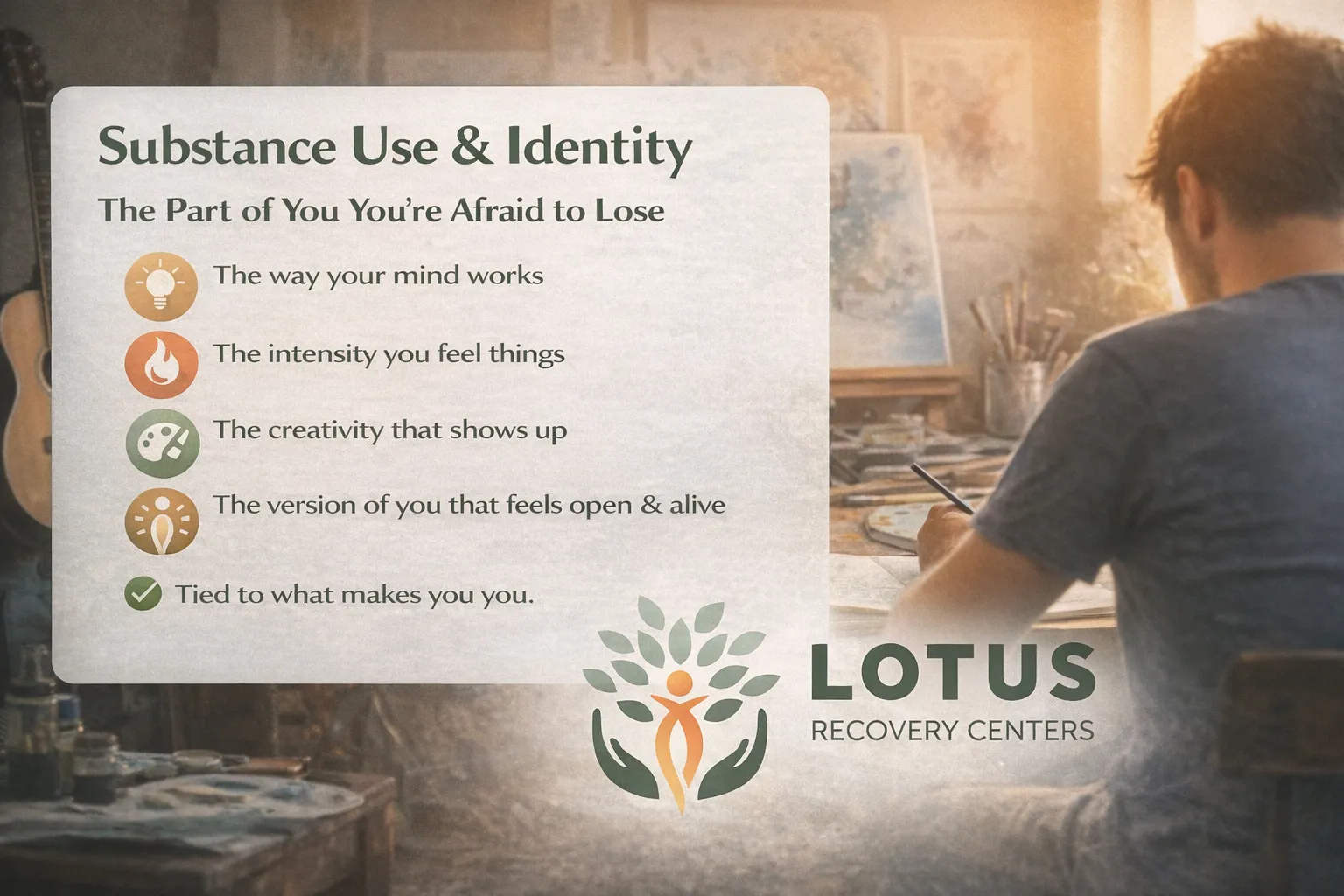
- The way your mind works
- The intensity you feel things
- The creativity that shows up when you’re in a certain state
- The version of you that feels more open, expressive, alive
There’s often a quiet thought underneath it all:
“If I change this, will I still be me?”
That question deserves to be taken seriously.
Because for you, this isn’t just behavior.
It’s tied to your voice, your art, your personality, your relationships—your sense of self.
The Myth That Pain Fuels Everything Real
Somewhere along the way, a belief starts to form:
That your creativity, your depth, your connection to others…
comes from the chaos.
That the same thing that hurts you is also what gives you something special.
So the idea of letting go doesn’t feel like relief.
It feels like risk.
You might think:
- “What if I can’t create the same way?”
- “What if I lose that emotional depth?”
- “What if I become… flat?”
And honestly? That fear doesn’t come out of nowhere.
You’ve experienced moments where things felt heightened. Where something meaningful came through.
But here’s what often gets missed:
Those moments came through you—not from the chaos itself.
The Version of You That Doesn’t Burn Out After
We’ve worked with people who had the exact same fear.
Artists. Musicians. Writers. People who feel everything intensely and translate that into something meaningful.
And at first, they hold back.
Not because they don’t want help—but because they don’t want to lose access to themselves.
But something shifts over time.
Not all at once. Not dramatically.
Just enough for them to notice:
- They can still feel deeply
- They can still think creatively
- They can still access ideas
The difference?
They don’t crash as hard afterward.
They don’t lose entire days trying to recover from the intensity.
They don’t feel like their creativity is tied to self-destruction anymore.
If you’re curious how that kind of support can exist without taking away who you are, you can explore these medication-supported recovery options. No pressure—just a place to understand what’s possible.
What If You’ve Been Carrying More Than Just “You”?
This part can feel uncomfortable.
Because it challenges a story you might have held onto for a long time.
What if some of what you call “your personality”
is actually a mix of:
- Survival responses
- Emotional overload
- Coping patterns that developed over time
Not fake. Not wrong.
Just… layered.
And when those layers begin to settle, something surprising happens:
You don’t become less yourself.
You become more specific.
More intentional.
Like tuning an instrument that’s been slightly off for years.
The Difference Between Intensity and Depth
It’s easy to confuse the two.
Intensity feels like everything all at once.
Depth feels like being able to stay with something.
One burns fast.
The other lasts.
A lot of people worry they’ll lose their intensity.
And in some ways, they might.
But what they gain instead is depth.
The ability to:
- Sit with an idea longer
- Explore emotion without being overwhelmed
- Create without needing to escape right after
It’s a quieter kind of power.
But it’s more sustainable.
The Fear of Becoming “Boring”
Let’s just say it out loud.
There’s a fear that life will become predictable.
That you’ll lose your edge.
That you’ll feel like a version of yourself you don’t recognize.
But what most people actually experience isn’t boredom.
It’s space.
Space to think.
Space to choose.
Space to respond instead of react.
And inside that space, something new has room to grow.
Not a dull version of you.
A grounded one.
You’re Allowed to Want Both
This doesn’t have to be all-or-nothing.
You don’t have to choose between:
- Being creative or being stable
- Feeling deeply or feeling safe
- Being expressive or being supported
You’re allowed to want both.
And more importantly—you’re allowed to explore what that looks like without committing to a full identity shift overnight.
If you’re starting to think about what support could look like in a way that still respects who you are, you can look into treatment options in Delaware. Just information. No pressure.
The First Moment You Feel Like Yourself Again
There’s a moment people describe.
It doesn’t happen immediately.
But it comes.
Where they pause and realize:
“I still think the same way.”
“I still feel things deeply.”
“I still have ideas.”
But this time, there’s less noise around it.
Less urgency.
Less chaos.
And more control over what they do with it.
That moment matters.
Because it rewrites the fear.
Creativity That Doesn’t Cost You Everything
This is where things start to shift in a meaningful way.
Creativity stops being something that comes with a price.
You don’t have to:
- Push yourself to the edge to access it
- Lose sleep to hold onto it
- Worry that it disappears if your life becomes more stable
Instead, it becomes something you can return to.
Something that’s part of you—not something you have to chase or force.
And for many people, that’s the first time creativity actually feels sustainable.
You Don’t Have to Solve This All Today
This isn’t a decision you need to make all at once.
You don’t need to:
- Label yourself
- Commit to a full plan
- Figure out your entire future
You can start with a question.
“What would it look like to feel like myself… without feeling this exhausted?”
And then just stay with that question for a while.
FAQs About Creativity, Identity, and Recovery
Will I lose my creativity if I get help?
No. What often changes is how you access it. Instead of relying on intensity or chaos, creativity becomes more consistent and sustainable.
What if substances are the only way I feel open or expressive?
It can feel that way, especially if that’s been your pattern for a long time. But many people find that openness doesn’t disappear—it just shows up differently, without the same cost.
Will I feel emotionally numb?
That’s a common fear. In reality, most people don’t lose emotion—they experience it with more stability and less overwhelm.
What if I don’t recognize myself anymore?
Change can feel unfamiliar at first. But most people report the opposite—they feel more like themselves, just without the constant pressure or instability.
Do I have to give up everything that defines me?
No. The goal isn’t to erase who you are. It’s to support you in a way that helps you keep what’s real and let go of what’s hurting you.
What if I’m not ready to fully commit?
That’s okay. You don’t have to be fully ready. You can start with curiosity, questions, and small steps.
Is it possible to feel both stable and creative?
Yes. And for many people, that’s when creativity actually deepens—because it’s no longer tied to burnout or emotional extremes.
The Version of You That’s Still There
You’re not trying to become someone new.
You’re trying to hold onto something real inside you—without losing yourself in the process.
And that version of you?
It’s not fragile.
It’s not dependent on chaos.
It’s still there.
It’s just waiting for a little more room to breathe.
You Don’t Have to Trade Yourself for Stability
You don’t have to disappear to get better.
You don’t have to become smaller, quieter, or less interesting.
You’re allowed to stay fully yourself—and still be supported.
Call (833)922-1615 or visit our medication assisted treatment in Wilmington, Delaware to learn more about.