

When I walked out of treatment the first time, I was proud. Not performative proud—real, earned, hard-won pride. I’d stayed the full program. I’d cried in group. I’d rewritten my narrative in my exit plan.
I was 90 days clean and convinced I’d figured it out.
And for a little while, it looked like I had.
But the truth crept back in slowly. Not with disaster, but with a whisper. A mental math problem about whether I could handle “just one” now. A growing tiredness in my body that therapy couldn’t seem to touch. A creeping edge of dread I couldn’t explain.
And then one night, I used again.
It took me three more weeks to admit it. And another month to walk back into a program—this time, open to a kind of help I used to avoid entirely.
This time, I said yes to a support option I once swore I didn’t need.
This is what changed—and what finally started to work.
I Didn’t Think “People Like Me” Used Medication
Let me be honest about something I hate admitting:
I judged people who took meds in recovery.
Not loudly, not rudely—but quietly. Silently. I saw it as a crutch. A shortcut. A sign you weren’t really ready to do the hard emotional work. I bought into the idea that if you “really wanted it,” you’d push through the cravings on grit alone.
I thought I was the kind of person who could muscle through.
I wasn’t.
Because the truth is, recovery doesn’t reward toughness. It rewards resourcing. It rewards honesty about what your body and mind actually need to heal.
I Didn’t Relapse Because I Forgot What I Learned
I could still recite the workbook. Still explain cognitive distortions. Still repeat the group mantras. But my brain? It wasn’t having it.
The cravings didn’t ask for permission. The exhaustion didn’t wait for a therapy appointment. My nervous system wasn’t impressed with what I knew—it responded to what I felt.
And what I felt, 90 days out, was this strange blend of pride and panic. I’d done everything “right,” and I still couldn’t get through a weekend without fantasizing about how good it would feel to check out.
I didn’t relapse because I wasn’t trying. I relapsed because I was trying to outrun a fire without water.
Medication didn’t fix everything. But it finally brought the hose.
Coming Back Was Embarrassing—Until It Wasn’t
Let’s be real: I didn’t want to go back. Not because I didn’t want help, but because I didn’t want to be the person who needed help again.
That walk through the door the second time? It felt heavier than the first.
But something shifted fast.
Nobody said, “Didn’t we already do this with you?”
Nobody looked surprised.
Nobody needed an explanation that started with shame.
They just welcomed me. Like I belonged. Still.
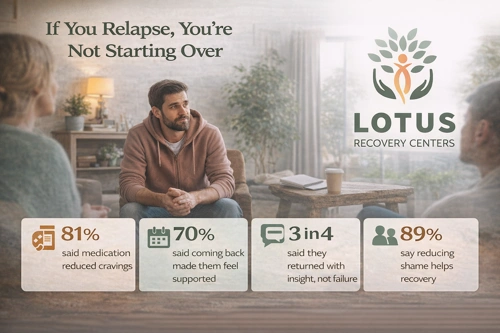
And for the first time, I started to believe that relapse didn’t cancel out recovery. It just rerouted it.
I Didn’t Lose My Progress—But I Had to Let Go of My Ego
I thought I was starting over. But I wasn’t.
I knew more about myself this time. I had language. I had boundaries. I had a record of what worked and what didn’t.
What I had to let go of wasn’t my clean time. It was my pride. The part of me that wanted to say, “I did this without meds. I did this clean. I did this fast.”
That voice had to shut up so I could live.
This round, I said yes to a care plan that included stabilization. Yes to medications that dulled the cravings enough for me to sleep at night. Yes to a team who didn’t care how I should be doing—they cared how I was doing.
Recovery This Time Is Quieter—and More Honest
First time around, I made recovery loud. I wanted people to see it.
I told my story. I filled notebooks. I shared every insight like it was gospel. And maybe that helped someone—but looking back, I think I was trying to convince myself I was safe.
This time, I don’t need an audience.
I need sleep.
I need clarity.
I need a brain that isn’t playing tug-of-war with itself every second of the day.
Medication gave me enough calm to listen to what my recovery was actually asking of me: consistency, humility, and time.
That was hard to hear when I was always in performance mode. It’s easier now. Because I’m actually healing.
If You’re in Delaware, There’s a Place That Gets It
I didn’t come back to a lecture. I came back to people who knew that relapse doesn’t mean you’re lying or lazy—it means something still needed care.
At Lotus Recovery Centers, I found help in Delaware that matched where I actually was—not where I thought I should be.
No shame. No side-eye. Just options.
They gave me space to ask questions, to change my mind, to try again. And they gave me access to medical support without pressure or judgment. Just a new plan, for a new round of recovery that wasn’t about proving anything—it was about staying alive.
Frequently Asked Questions (FAQ)
Did you resist medication at first?
Absolutely. I told myself it wasn’t for me. That I wasn’t “that kind of addict.” But when I relapsed, I realized I had been white-knuckling through cravings I didn’t understand. I finally saw medication not as a weakness, but as relief.
Did it change how you felt emotionally?
Yes—and not in the way I feared. I thought it would make me numb. What it actually did was lower the volume on cravings and anxiety just enough for me to be present in group, in therapy, and in my relationships.
Was it hard to come back after relapsing?
It was one of the hardest things I’ve ever done. But once I did it, I realized how much of my shame was just internal noise. Nobody treated me like a failure. They treated me like someone still trying—and that meant everything.
Are you still using medication now?
Yes, and I’m closely monitored by a clinician. There’s no pressure to stay on it forever—but also no shame if I do. It’s not a badge or a crutch. It’s just something that’s helping me stay here while I keep building my foundation.
What advice would you give someone considering coming back?
Don’t let your pride write your obituary. Come back. Ask for more help. Say yes to what you used to be scared of. There’s no timeline for healing—just an open invitation to try again.
Call When You’re Done Proving and Ready to Heal
You don’t have to “deserve” another chance. You don’t need a script about why this time will be different. You just need a little bit of willingness—and people who won’t shame you for stumbling.
That’s what I found at Lotus. That’s what you’ll find, too.
Call 833-922-1615 to learn more about our medication-assisted treatment services in Delaware.
Coming back doesn’t mean you failed. It means you still want to live. Let’s start there.