

You still go to work.
You still answer calls, show up for your family, pay your bills, and handle responsibilities. From the outside, your life probably looks stable enough that nobody questions it.
That’s what makes this kind of drinking so hard to talk about.
A lot of people assume alcohol only becomes a problem once someone loses everything. But many high-functioning adults spend years quietly struggling while continuing to maintain careers, relationships, routines, and appearances.
That’s why so many people end up Googling questions late at night that they never say out loud during the day.
Questions like:
- “Is drinking every night actually bad if I still function?”
- “Can you have a problem and still keep a job?”
- “Am I overreacting?”
- “Why do I feel so exhausted all the time?”
At Lotus Recovery Centers’ structured recovery programs, we meet people in that exact middle space all the time — not falling apart publicly, but privately feeling overwhelmed, emotionally drained, and increasingly dependent on alcohol to cope.
High-Functioning Drinking Often Hides in Plain Sight
One of the biggest misconceptions about alcohol use is that it always looks chaotic.
Sometimes it looks polished.
Sometimes it looks like the manager who never misses work but drinks alone every night after everyone goes to sleep. Sometimes it’s the parent who keeps the household running while secretly counting down the hours until they can finally pour a drink. Sometimes it’s the professional who seems confident in meetings but feels emotionally frayed underneath everything.
High-functioning people are often incredibly skilled at maintaining appearances.
That’s part of why this becomes so lonely.
The outside world rewards productivity. If you’re still getting things done, people assume you’re okay. You may even convince yourself you’re okay because your life hasn’t completely collapsed.
But functioning and suffering can exist at the same time.
And honestly, many people don’t realize how much pain they’re carrying until they finally stop long enough to look at it honestly.
Alcohol Starts as Relief Before It Starts Feeling Necessary
Most people do not wake up one morning planning to become dependent on alcohol.
It usually begins in ways that feel understandable.
A drink after stressful workdays. A way to quiet anxiety. Something that helps you sleep faster. Something that softens loneliness or numbs pressure for a few hours.
At first, it can genuinely feel helpful.
That’s why this gets complicated.
For many high-functioning adults, alcohol becomes less about partying and more about emotional survival. It becomes the transition between work mode and rest. The thing that turns the volume down inside your head.
Then slowly, over time, the relationship changes.
You may notice:
- Drinking earlier than you used to
- Feeling irritated when alcohol isn’t available
- Needing more drinks to relax
- Promising yourself you’ll skip tonight, then changing your mind
- Feeling anxious or restless without it
- Structuring evenings around drinking
- Waking up exhausted, foggy, or emotionally flat
These are often functioning alcoholic signs people dismiss because they still appear “successful.”
But the body and mind usually know something is wrong long before life visibly falls apart.
The Exhaustion Is Bigger Than the Hangover
The people we work with often talk less about hangovers and more about emotional fatigue.
The exhaustion of hiding.
The exhaustion of pretending everything is fine.
The exhaustion of constantly negotiating with yourself:
- “I’ll only have two tonight.”
- “I deserve this after today.”
- “Tomorrow I’m cutting back.”
- “It’s not that serious.”
- “Other people drink more than I do.”
That mental loop wears people down over time.
One client described it this way:
“I wasn’t drinking to have fun anymore. I was drinking to recover from my own life.”
That sentence hits because a lot of high-functioning adults understand exactly what it means.
Alcohol stops feeling recreational. It starts feeling like maintenance.
And maintenance becomes exhausting.
The Hardest Part Is Often Admitting It to Yourself
Many people are surprisingly honest with themselves privately.
They know something feels off.
But they struggle to call it a problem because they compare themselves to extreme examples of addiction they’ve seen in movies, online, or in other people’s lives.
So they minimize:
- “I’ve never gotten a DUI.”
- “I’m still paying my bills.”
- “I don’t drink in the morning.”
- “I’m not blacking out.”
- “I still go to work every day.”
But addiction does not always arrive loudly.
Sometimes it arrives quietly through emotional dependency, isolation, anxiety, secrecy, and exhaustion.
Sometimes the warning sign is not catastrophe.
Sometimes the warning sign is realizing alcohol has become the only reliable way you know how to relax, feel okay, or escape your thoughts.
That matters.
And deep down, many people already know it matters.
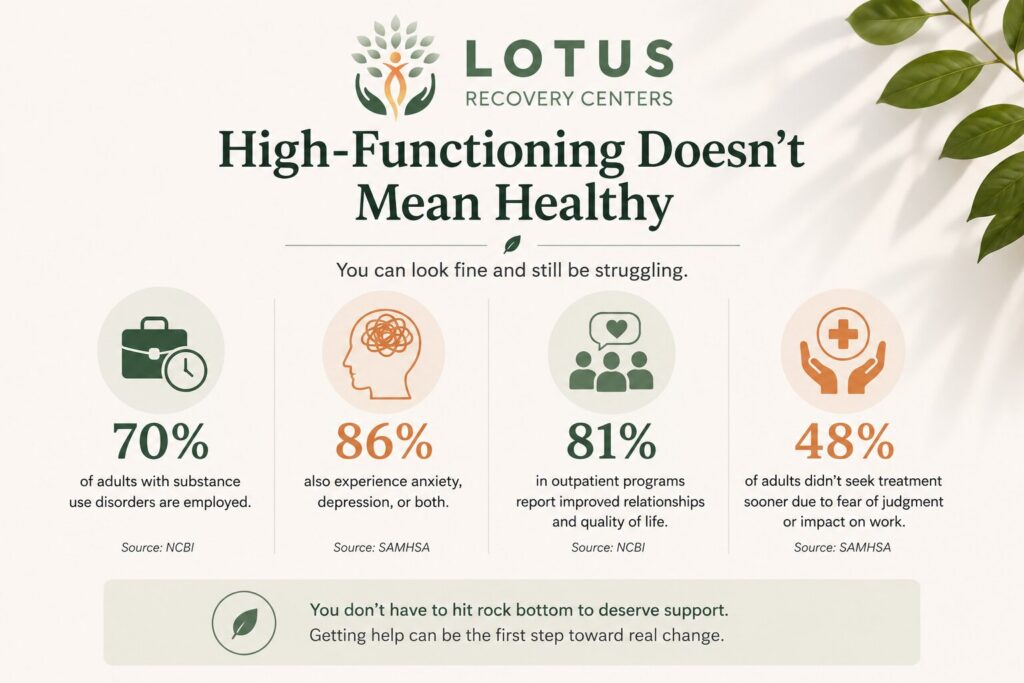
High-Functioning People Usually Wait Too Long
One of the saddest patterns we see is how long high-functioning adults wait before asking for help.
Because externally, life still works.
Until eventually it doesn’t.
Relationships become emotionally distant. Anxiety worsens. Depression deepens. Sleep becomes terrible. Irritability increases. Motivation disappears. People stop feeling connected to themselves.
Some begin experiencing panic attacks or health issues. Others feel emotionally numb all the time unless they’re drinking.
And many continue functioning through all of it because they’ve spent years learning how to perform normalcy.
That performance comes at a cost.
A lot of people don’t realize how much energy they spend managing alcohol until they stop. Managing the drinking. Managing appearances. Managing shame. Managing recovery from the night before.
It’s like carrying a backpack full of bricks so long that eventually you forget how heavy it is.
You Don’t Need to Hit Bottom to Deserve Support
This is important.
You do not need to destroy your life before your pain counts.
You do not need:
- An arrest
- A divorce
- Job loss
- Severe withdrawal symptoms
- Public humiliation
- Total collapse
…before you’re allowed to question your relationship with alcohol.
Some people seek support because they’re simply tired of feeling emotionally dependent on drinking every night.
That is enough.
Actually, getting help before things completely implode is often a sign of self-awareness, not failure.
At Lotus Recovery Centers, many clients arrive while they’re still functioning professionally. They still have jobs, responsibilities, and routines. What they’ve lost is peace.
And peace matters.
Recovery Often Begins With One Honest Thought
A lot of people think recovery begins with a dramatic moment.
Sometimes it does.
But more often, it starts quietly.
A thought during the drive home.
A moment staring at the ceiling at 2am.
A wave of exhaustion after another night of promising yourself “this will be the last one.”
It often begins with a question:
“What if I don’t actually want to keep living like this?”
Not because life is ruined.
Because you’re tired of surviving it this way.
That moment deserves attention.
Not shame. Not panic. Just honesty.
And honesty can become the beginning of something better.
You Are Allowed to Want More Than “Still Functioning”
A lot of high-functioning adults set the bar painfully low for themselves.
“If I’m still working, I must be okay.”
But being alive and being well are not the same thing.
You deserve more than barely holding it together until the next drink.
You deserve sleep that actually restores you. Relationships that feel emotionally present. Evenings that don’t revolve around escape. A nervous system that doesn’t constantly feel overloaded.
Most importantly, you deserve support before things become unbearable.
For people looking for support in Delaware, talking honestly about nightly drinking, emotional exhaustion, or treatment options can be a powerful first step toward feeling like yourself again.
Frequently Asked Questions
Is drinking every night considered alcoholism?
Not necessarily, but drinking every night can become problematic depending on frequency, amount, emotional dependence, and how alcohol affects your mental and physical health. If alcohol feels necessary to relax, sleep, cope, or get through the day, it may be worth exploring further.
Can you still be successful and have a drinking problem?
Yes. Many high-functioning adults maintain careers, relationships, and responsibilities while privately struggling with alcohol dependence or emotional reliance on drinking.
What are some early warning signs that drinking is becoming a problem?
Some early warning signs include:
- Drinking more than planned
- Feeling anxious without alcohol
- Using alcohol to cope emotionally
- Thinking about drinking throughout the day
- Difficulty cutting back
- Hiding or minimizing drinking habits
- Feeling emotionally exhausted or dependent on alcohol to relax
Why do high-functioning people struggle to ask for help?
Many people compare themselves to extreme stereotypes of addiction and assume they are “not bad enough” to need support. Shame, fear, and maintaining appearances can also make it difficult to reach out.
Does outpatient treatment mean I have to stop working?
Not always. Many people participate in multi-day weekly treatment programs while continuing to work, manage family responsibilities, and live at home.
What if I’m not sure whether I need treatment?
You do not need to be completely certain before talking to someone. Many people begin by simply asking questions about stress, drinking patterns, emotional exhaustion, or support options.
Call (833)922-1615 or visit the Lotus Recovery Centers intensive outpatient program to learn more about our programs, iop services in Delaware.