

Sometimes it happens gradually.
One missed group turns into two.
Then your name stops showing up on the roster.
You didn’t mean to stop showing up. Maybe you got overwhelmed. Maybe work shifted, your energy dropped, or symptoms flared. Or maybe, if you’re being honest, something inside you pulled away—and you’re not even sure why.
Whatever led to stepping back, this moment right now matters more. The moment you’re considering coming back.
And you can come back.
This guide is here to help you do just that—gently, clearly, and without shame. At Lotus Recovery Centers, we know that recovery isn’t linear. We don’t expect perfection. And we’ll never punish you for pausing.
Here’s how to return to an intensive outpatient program (IOP) in a way that feels safe, supported, and possible.
1. First, Know This: You’re Not the Only One Who Left
We want to normalize something you might be afraid to say out loud: lots of people leave treatment before they meant to.
Some hit a bump. Some get scared. Some simply disappear because life got in the way.
And just as many come back—quietly, bravely, and often unsure if they’ll be welcomed.
You will be.
At Lotus, we believe in the open-door approach. That means we don’t shame you for leaving, and we don’t expect a perfect explanation. You’re not starting over. You’re continuing—at your own pace.
2. Reach Out in Whatever Way Feels Doable
We’re not here to make your return harder with red tape or formalities.
If making a phone call feels overwhelming, that’s okay. Send a message. Walk in. Ask someone you trust to call on your behalf. Let the method match your energy.
Here’s what we won’t do:
- Grill you about why you left
- Make you retell painful moments you’re not ready to talk about
- Talk down to you, even if you’ve been using again
What we will do:
- Say, “We’re glad to hear from you”
- Ask how we can support you now
- Help figure out the next best step—no pressure
If you’re closer to Prices Corner, we also offer support in that area. Just let us know what works best for you.
3. Let Go of the “I Messed It Up” Narrative
You might be telling yourself, “I had my chance and blew it.”
You didn’t.
Leaving treatment doesn’t erase the progress you made. It doesn’t mean the support is gone. And it definitely doesn’t mean you’re back at square one.
Progress can pause. That’s allowed.
One of the hardest parts of returning isn’t the logistics—it’s the internal guilt. That voice saying you should’ve stuck it out. That you won’t be trusted. That you’re too far gone.
We want to be clear: You are not beyond help. You’re not behind. And nothing about your re-entry needs to be a punishment.
4. Ask About Restart Options That Fit Your Life Now
You don’t have to know exactly what you need to come back.
That’s what we’re here for.
When you reach out, we’ll walk you through:
- Whether you can pick up where you left off
- What’s changed since your last session
- What structure would support you best now (daytime, evening, virtual, etc.)
- Whether a full re-assessment is necessary or not
We’re flexible—because people change, and recovery needs change too.
Whether you’ve had a rough couple weeks or you’ve returned to use, we can work with that. Compassion isn’t conditional here.
5. Expect Some Nerves—But Know They Fade
You might feel nervous about showing your face again. That’s natural.
You might worry what the group will think.
You might fear you’ll be seen as unreliable.
You might even think, “What if I can’t do it again?”
But here’s the thing: returning takes guts.
The kind of courage most people never even tap into.
You’re not weak for coming back. You’re brave. And even if your hands shake during check-in, even if your voice cracks, even if you leave the first session exhausted—it still counts.
Recovery isn’t about performing strength. It’s about returning to yourself, even when it’s awkward or slow.
6. Don’t Rush to “Make Up” for Lost Time
One of the most tempting traps is trying to “catch up.”
You missed a few weeks, or months, and now you feel like you have to double-down. Do everything right. Be the model client. Rush your healing.
Please don’t.
You’re allowed to ease in. You’re allowed to not be ready to share in group right away. You’re allowed to take small steps instead of big leaps.
At our intensive outpatient program in Wilmington, DE, our job is to walk with you—not pull you along.
We want you to feel like you can breathe again. To feel steady again. And that doesn’t come from sprinting. It comes from rooting.
7. See Re-Entry as a Continuation, Not a Failure
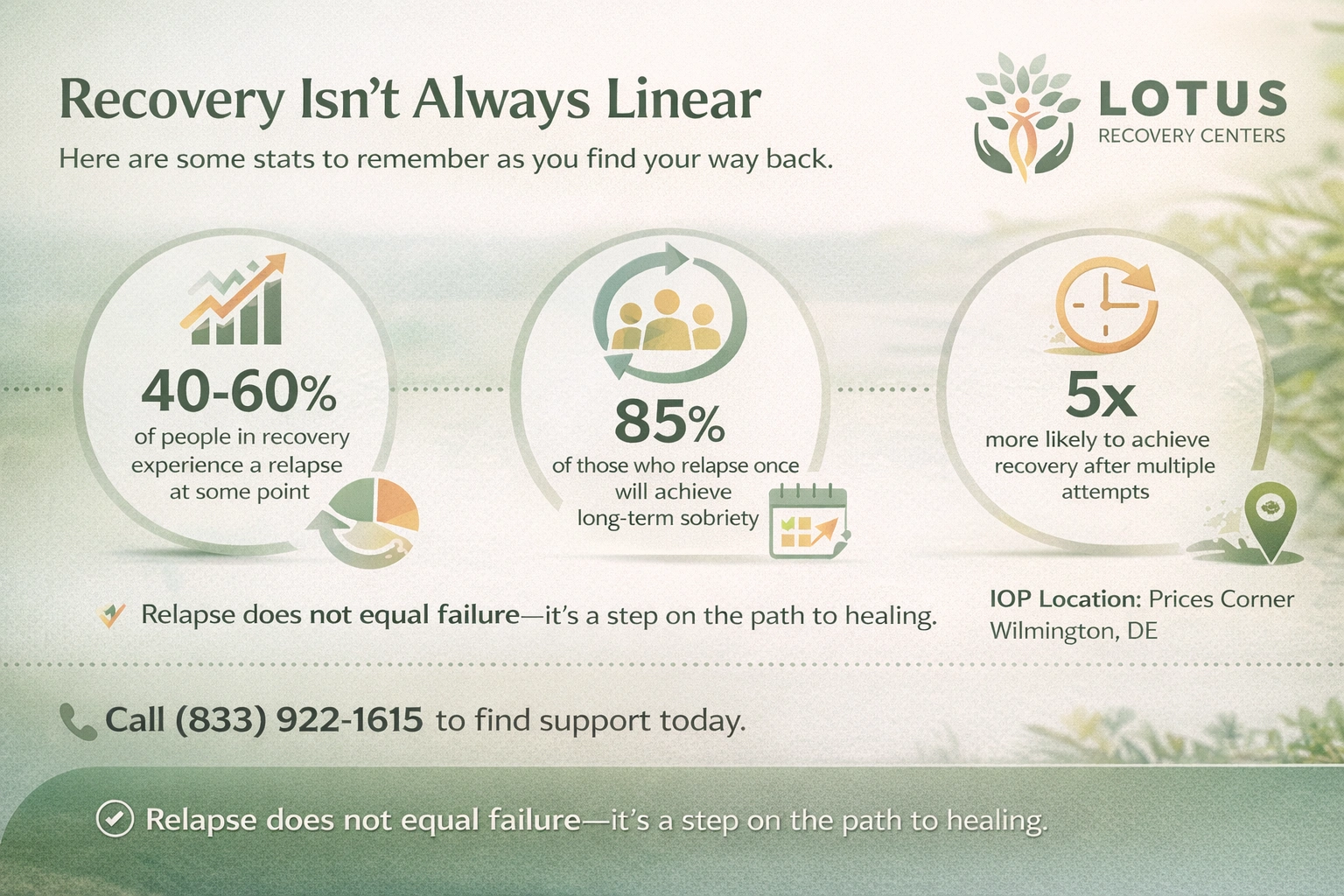
The truth is, many people who achieve long-term recovery do so after multiple attempts. The important thing isn’t how many times you paused—it’s that you didn’t give up.
Coming back is recovery.
It’s proof that part of you still wants more. Still believes it’s possible. Even if that part feels small right now, we’ll help it grow.
Whether you’re seeking structure after a few rough weeks, or reconnecting after a deeper spiral, this program still has space for you.
And so do we.
What Clients Say After Coming Back
“I was so embarrassed to call. But when they answered, the first thing they said was ‘We’re so glad you reached out.’ That’s all I needed.”
– Former IOP Client, Wilmington
“I thought I’d have to start over from scratch. But they let me pick up where I left off—and this time, it just clicked differently.”
– Group Participant, 2023
Quick Tips for Rejoining IOP After a Break
- Text if calling feels hard. You don’t need to explain everything at once.
- Ask to speak with someone you already worked with—familiar faces help.
- Be honest about what’s changed, even if it’s messy.
- Expect warmth, not interrogation.
- Let yourself be new here again. That’s not failure—it’s growth.
Finding Support Near You
If you’re looking for an intensive outpatient program in Prices Corner, Delaware, our nearby locations can help ease your re-entry. We’ll meet you where you are—literally and emotionally.
FAQs About Returning to an IOP Program
Can I come back if I was discharged for non-attendance?
Yes. At Lotus Recovery Centers, we understand that life gets in the way. You’re welcome to return, and we’ll help you figure out the best way to re-engage.
Will I have to restart the whole program?
Not necessarily. It depends on how long you’ve been away and how much structure you need now. Some clients pick up where they left off. Others benefit from a fresh start. We’ll talk through it together.
Do I have to explain why I left?
Only if you want to. There’s no interrogation, and we won’t demand an explanation. Your story is yours to share—or not.
What if I used again during the time I was gone?
That’s okay. You won’t be judged or turned away. In fact, your return after a lapse shows strength. We’ll support you from where you are now—not where you “should” be.
What if I’m not sure I’m ready?
That’s valid. You don’t have to feel 100% confident. Just curious enough to ask. Let’s talk it through. No pressure, no push.
How do I start the process?
Call us at (833) 922-1615 or visit our IOP program page. We’ll guide you through next steps, gently and clearly.
Ready to Reconnect?
Call (833) 922-1615 to learn more about our intensive outpatient program services in Wilmington, DE. You’re not too late, too far gone, or too complicated. You’re just in need of a soft place to land—and that’s what we’re here for.