

You don’t need to have it all figured out to come back.
You just need a small moment where you’re honest enough to consider trying again.
If you’ve been avoiding that call or replaying how things ended, this isn’t about judgment. It’s about reopening something that was never fully closed.
Start With the Truth You’ve Been Carrying
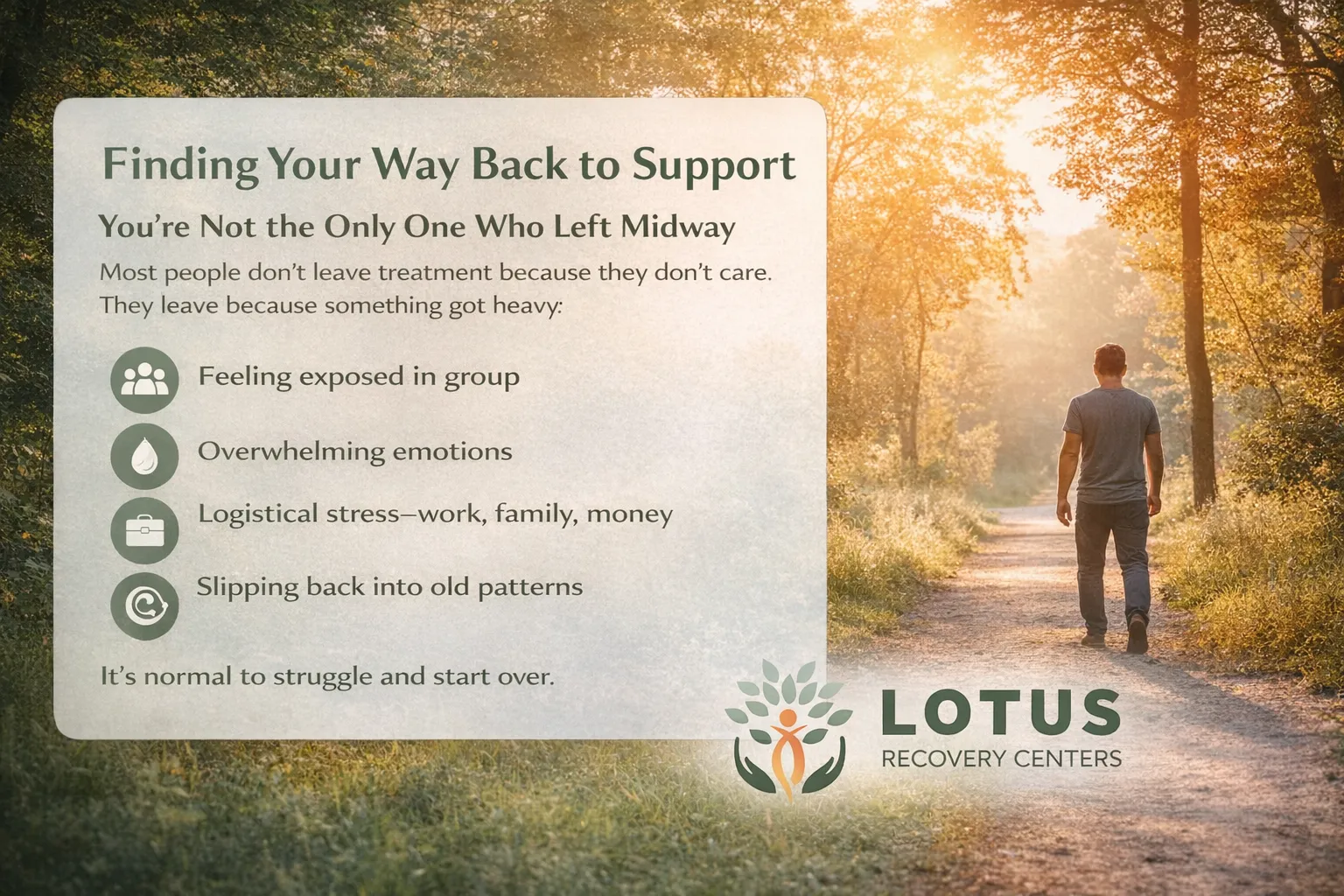
Most people don’t leave treatment because they don’t care.
They leave because something inside or outside of them got heavy.
Maybe it was:
- Feeling exposed in group
- Getting overwhelmed by emotions you weren’t ready to face
- Logistical stress—work, family, money
- Or slipping back into old patterns and feeling too ashamed to show up
You don’t need to fix any of that before reaching out.
You just need to tell the truth about it.
That truth can be simple:
“I stopped coming because it got hard.”
“I didn’t know how to keep going.”
“I felt like I was falling behind.”
There’s no script required here. Real honesty lands better than a perfect explanation.
You’re Not the Only One Who Left Midway
This might feel like something only you did. Like you’re the one person who couldn’t “stick with it.”
That’s not reality.
People pause treatment all the time. They disappear for weeks, months—even longer. Life gets complicated. Emotions catch up. Avoidance creeps in.
And then something shifts.
A bad day. A quiet realization. A moment where continuing the same way feels heavier than trying again.
That’s usually where reconnection begins.
From a clinical perspective, this isn’t failure.
It’s part of the process.
Reach Out Before You Feel Ready
A lot of people wait for the “right time” to come back.
They tell themselves:
- “I need to get stable first.”
- “I’ll reach out once I’ve stopped using again.”
- “I don’t want to show up like this.”
But here’s the truth:
If you wait until you feel fully ready, you might never reach out.
Readiness doesn’t come first. Action does.
You don’t have to feel confident. You don’t have to feel proud.
You just have to be willing to take one small step.
That step could look like:
- Saving the number in your phone
- Opening the website and sitting with it
- Sending a one-line message
If you’re unsure where to begin, you can start by exploring your options through this intensive outpatient support. You don’t have to commit—you’re just gathering your footing.
The Shame Loop That Keeps You Stuck
Let’s name the thing that actually stops most people:
Shame.
Not just “I made a mistake” shame.
The deeper kind.
The kind that says:
- “They’re going to judge me.”
- “I already wasted their time.”
- “I should’ve done better.”
- “I don’t deserve another chance.”
Shame convinces you that going back will be more painful than staying stuck.
But here’s what shame gets wrong:
Treatment spaces are designed for imperfection.
Clinicians don’t expect a straight line.
They expect real life.
And real life includes stopping, struggling, avoiding, and coming back.
What Actually Happens When You Reach Out Again
A lot of fear comes from imagining the worst-case scenario.
You might picture:
- Being interrogated about why you left
- Being judged or dismissed
- Having to start completely over
That’s rarely how it works.
More often, the first step back is simple:
A conversation.
You’ll likely be met with something like:
“Hey, it’s good to hear from you. How have you been?”
Not punishment. Not pressure. Just a door opening.
From there, things can be adjusted:
- Your schedule
- Your level of support
- The pace of your care
You’re not stepping back into the exact same place—you’re stepping into something that fits where you are now.
You Don’t Have to “Earn” Your Way Back
This is one of the most harmful beliefs people carry.
“I need to fix myself a little before I go back.”
But treatment isn’t a reward for doing well.
It’s support for when things aren’t going well.
You don’t need to:
- Be sober for a certain number of days
- Have everything under control
- Prove that you’re serious
You’re allowed to come back as you are—messy, unsure, and still figuring it out.
That’s actually the best time to come back.
Quick Ways to Reconnect Without Overthinking It
If everything feels too big, shrink the step.
Here are simple ways to start:
- Write a message and don’t send it yet—just get the words out
- Save the number and sit with it for a few minutes
- Ask a friend or family member to sit nearby while you call
- Remind yourself: “This doesn’t have to be perfect”
- Set a timer for 5 minutes and take one small action
You’re not trying to solve everything today.
You’re just interrupting the silence.
Rebuilding Trust—With Them and With Yourself
Coming back isn’t just about reconnecting with a program.
It’s also about rebuilding trust within yourself.
That can feel fragile at first.
You might wonder:
“Will I follow through this time?”
“What if I leave again?”
Those are valid questions.
But trust doesn’t come from guarantees.
It comes from showing up in small, consistent ways.
One call.
One session.
One honest conversation.
That’s how it starts.
If You’ve Slipped Since Leaving, You’re Still Welcome
This is important.
A lot of people don’t return because things got worse after they left.
They think:
“I can’t go back now—it’s worse than before.”
But that’s exactly why coming back matters.
You’re not expected to return in better shape.
You’re invited to return in real shape.
Whatever’s happened since you left—using again, isolating, struggling mentally—doesn’t disqualify you.
It makes support more relevant, not less.
You’re Allowed to Take Up Space Again
There’s a quiet belief that once you disappear, your spot is gone.
That you missed your chance.
That people moved on.
But that’s not how care works.
You are allowed to come back and take up space again.
You are allowed to be seen again.
You are allowed to need help again.
Even if you left quietly.
Even if you didn’t say goodbye.
Even if it’s been a long time.
Finding Your Way Back to Support
Reconnection doesn’t have to be complicated.
Sometimes it starts with simply exploring what support could look like now—not what it looked like before.
If you’re considering stepping back into care, you can look into treatment options in Delaware to find a setting that feels more aligned with where you are today.
Different doesn’t mean starting over.
It means adjusting.
FAQs About Returning After Leaving Treatment
Can I really come back after ghosting treatment?
Yes. This happens more often than you think. Programs are used to people stepping away and returning. You won’t be turned away just because you stopped showing up.
Do I have to explain why I left?
No. You can share as much or as little as you’re comfortable with. A simple “I’m ready to reconnect” is enough to start the conversation.
Will I have to start over completely?
Not necessarily. Your situation will be reassessed, but that’s about meeting your current needs—not erasing your progress.
What if I’ve relapsed or things got worse?
You’re still welcome. In fact, this is one of the most important times to come back. You don’t need to fix anything before reaching out.
What if I feel too embarrassed to call?
That feeling is incredibly common. Try taking a smaller step—writing a message, visiting the website, or asking someone to sit with you while you call. You don’t have to push through it alone.
Will they judge me for leaving?
Clinicians are trained to understand that recovery isn’t linear. Their focus is helping you move forward—not judging where you’ve been.
What if I leave again?
That fear is valid. But the goal isn’t perfection—it’s progress. Even coming back once is a meaningful step forward.
One Small Step Is Enough
You don’t need to rebuild everything today.
You don’t need to prove anything.
You just need one honest step.
Call (833)922-1615 or visit our Intensive Outpatient Program in Wilmington, Delaware to learn more about our programs.