

You’re showing up.
You’re getting things done.
From the outside, nothing looks off.
But there’s that quiet calculation happening every day—how much you can drink, when, and how to still function tomorrow.
If you’ve been wondering whether there’s a way to get help without walking away from your job, you’re not alone. And you’re not unrealistic for wanting that.
There are options like flexible treatment programs that work around your schedule—and they exist for people exactly like you.
You’re Not “Fine”—You’re Just Good at Managing It
Let’s not sugarcoat it.
You’ve built a system that works—at least on the surface.
You know how to:
- Pace your drinking so you’re functional the next day
- Keep conversations sharp enough that no one questions you
- Push through fatigue, headaches, or that low-level anxiety
And for a while, that system holds.
But over time, the margin gets thinner.
What used to feel manageable starts to feel… heavier.
Not dramatic. Just constant.
That’s the part most people don’t see.
And it’s the part that eventually catches up.
The Lie: You Have to Choose Between Work and Getting Help
This belief is sticky because it sounds logical.
“If I get help, I’ll have to step away from everything.”
“I can’t disappear for weeks—I have responsibilities.”
So the conclusion becomes: not now.
But that “not now” turns into months. Sometimes years.
Here’s the reality most people don’t hear early enough:
There are structured ways to get help that don’t require you to step out of your life completely.
Not shortcuts. Not half-measures.
Just options that respect the fact that you have a career, a schedule, and people depending on you.
What It Actually Looks Like to Get Help Without Leaving Your Job
This isn’t about squeezing recovery into whatever time you have left at the end of the day.
It’s about building a routine that supports you instead of drains you.
For many people, that looks like:
- Attending sessions before work or after your 9 to 5
- Committing to multiple days per week without it taking over your entire schedule
- Having consistent support while still staying engaged in your daily life
It’s structured—but flexible enough to work in the real world.
And this is where people begin exploring outpatient alcohol treatment Wilmington options that fit into their routine instead of replacing it.
Because the goal isn’t to remove you from your life.
It’s to help you function within it without relying on alcohol.
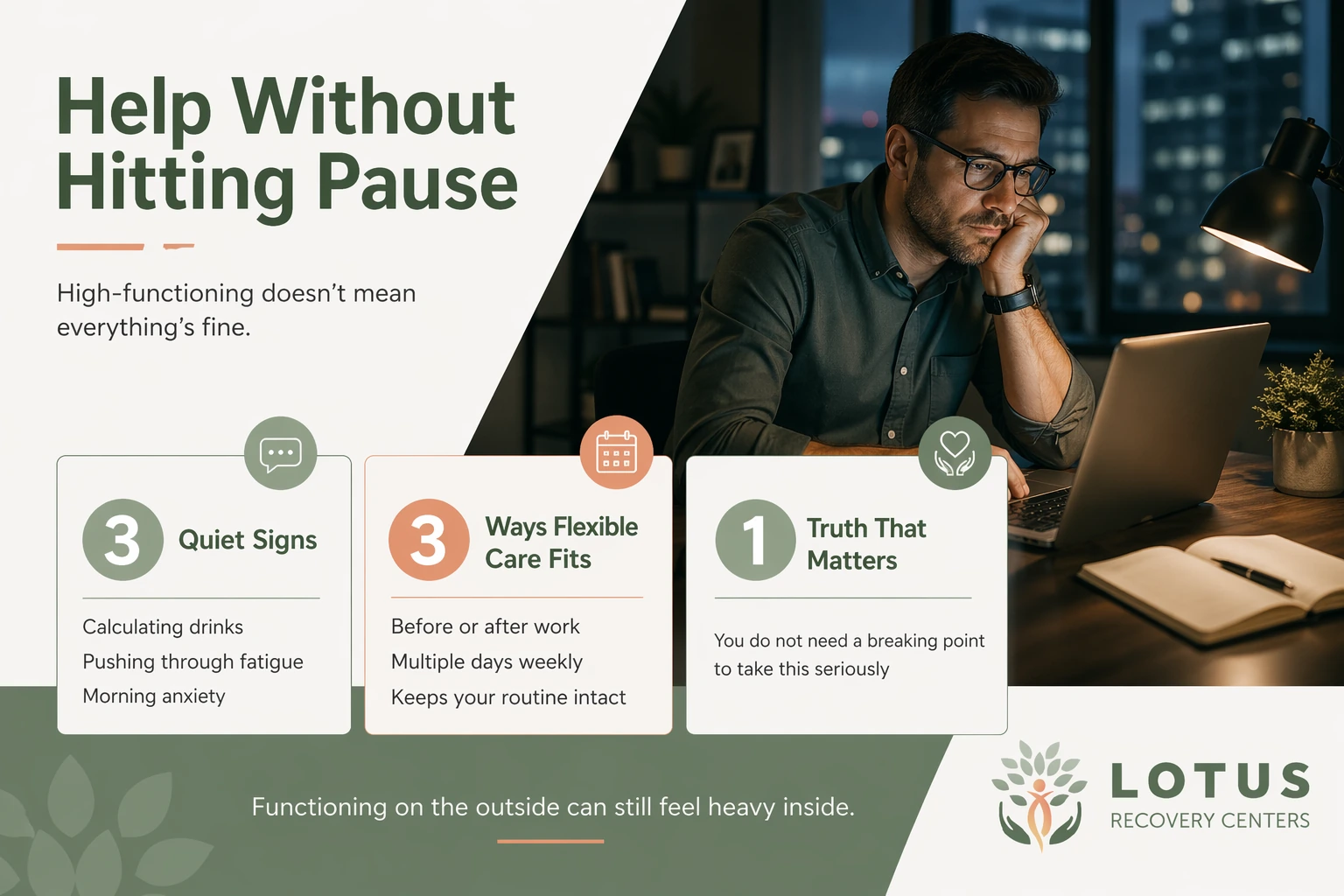
You Don’t Need a Breaking Point to Take This Seriously
A lot of high-functioning people wait.
Not because they don’t see the issue—but because it doesn’t feel urgent enough.
No one has called you out.
Nothing has fallen apart.
So it’s easy to say, “I’ll deal with it later.”
But here’s the thing about later—it rarely shows up the way you expect.
Instead, it builds quietly:
- More reliance on alcohol to unwind
- Less energy in the mornings
- More mental space taken up by managing drinking
You don’t need a crisis to make a change.
Sometimes the most honest moment is a simple one:
I don’t want to keep doing this forever.
That’s enough.
The Cost You’re Carrying (Even If No One Sees It)
High-functioning doesn’t mean unaffected.
It just means you’ve gotten good at hiding the impact.
But if you’re being real with yourself, there’s a cost:
- You’re more tired than you used to be
- Your patience runs thinner
- You rely on alcohol to transition out of your day
- You’ve started to question how sustainable this is
It’s not loud.
It’s not dramatic.
It’s just there—every day.
And ignoring it doesn’t make it smaller.
It just makes it more familiar.
Getting Support Isn’t Losing Control—It’s Reclaiming It
This is where a lot of people hesitate.
Because it feels like stepping into treatment means giving something up.
Control. Privacy. Independence.
But take a step back for a second.
Right now, alcohol is already shaping:
- When your day ends
- How your nights go
- How your mornings feel
- How much energy you actually have
That’s not full control.
Getting support doesn’t take your autonomy away.
It gives you more say in how your life actually feels.
You Can Keep Your Identity and Still Change This
There’s another fear underneath all of this.
If I change this, do I become someone else?
Especially if alcohol has been tied to:
- Socializing
- Relaxing
- Celebrating
- Even just feeling like yourself after a long day
It makes sense to question what life looks like without it.
But here’s what people don’t expect:
You don’t lose your personality.
You don’t lose your edge.
You don’t suddenly become someone unrecognizable.
What changes is the dependency.
You still unwind.
You still connect.
You just don’t need alcohol to make it happen.
You’re Not the Only One Doing This Quietly
This part matters more than most people realize.
A lot of high-functioning people think they’re the exception.
That everyone else who seeks help must be in a worse place.
But if you sat in a room with others in similar programs, you’d hear things that sound familiar:
- People who never missed work
- People who kept up appearances for years
- People who said, “I didn’t think I qualified for help”
You’re not behind.
You’re not overreacting.
You’re noticing something early enough to do something about it.
The First Step Is Smaller Than You Think
You don’t have to commit to a full overhaul today.
You don’t have to have every answer.
The first step can be as simple as:
- Learning what your options are
- Talking to someone who understands your situation
- Seeing what kind of support actually fits your life
If you’re in or near Delaware, there are real, grounded options for care in Delaware that are built for people balancing work and recovery.
No pressure. No assumptions.
Just clarity.
What People in Your Position Usually Wish They Did Sooner
If you ask people who’ve been where you are now, you’ll hear similar things:
- I wish I didn’t wait until I was exhausted
- I wish I knew there were options that fit my schedule
- I wish I stopped trying to manage it alone
Not because everything fell apart.
But because it didn’t have to get as hard as it did.
FAQs: Real Questions High-Functioning People Ask
Can I really get help without taking time off work?
Yes. Many people attend structured support sessions outside of standard work hours. The goal is to make recovery fit into your life, not replace it.
What if my drinking hasn’t caused major problems yet?
That’s actually when change can be most effective. You don’t need visible consequences to justify getting support. If it’s affecting how you feel day-to-day, it matters.
Will people find out if I get help?
Programs are designed with privacy in mind. Many people in similar situations value discretion, and support systems reflect that.
What if I try this and it doesn’t work?
That fear is valid. But not all approaches are the same. Sometimes it’s about finding the right structure and support—not forcing something that doesn’t fit.
Do I have to stop drinking forever to start?
Not necessarily. The first step is often about understanding your relationship with alcohol and building awareness. From there, you decide what change looks like.
How do I know if I actually need help?
If you’re thinking about it this much, it’s worth exploring. You don’t have to label yourself or hit a specific threshold. Curiosity is enough to start.
You Don’t Have to Keep Balancing This Alone
You’ve handled a lot on your own already.
That’s clear.
But handling everything alone doesn’t have to be the standard you hold yourself to forever.
There are ways to keep your job, your responsibilities, your routine—and still change what’s not working.
You don’t have to choose between your life and getting better.
You can build something that supports both.
Call (833)922-1615 or visit our Intensive Outpatient Program in Wilmington,Delaware to learn more about your options.
Just a real conversation.
No pressure.
No need to have it all figured out before you reach out.