

You don’t need to hit rock bottom to want a reset.
Maybe you’ve been quietly wondering what life could look like without that glass of wine to wind down, or the pill that turns the volume down in your head. Maybe it’s not every day. Maybe it’s not “bad.” But maybe you’ve noticed… it’s not optional anymore.
And part of you is starting to wonder:
What if I didn’t need this?
What would it feel like to wake up clear again?
Am I allowed to explore sobriety if I’m not in crisis?
Yes. You are. And you’re not alone.
At Lotus Recovery Centers, we help people who are sober curious, not just substance-dependent. People who are functioning, but tired. People who don’t want to wait until they break to make a change.
If you’re ready to explore sobriety—but want support that’s realistic, compassionate, and science-backed—here’s how to do it with medical and emotional support.
You Don’t Need a Label to Want Help
Here’s what keeps a lot of people stuck: the idea that unless they “have a problem,” they don’t deserve help.
But here’s the truth:
- You don’t need to call yourself an alcoholic to want fewer hangovers.
- You don’t need to crash your car to realize drinking is messing with your peace.
- You don’t need a diagnosis to say, “This isn’t working for me anymore.”
If something in your life is stealing clarity, joy, or your ability to feel present—you’re allowed to get curious about changing it.
There’s no entrance exam for care.
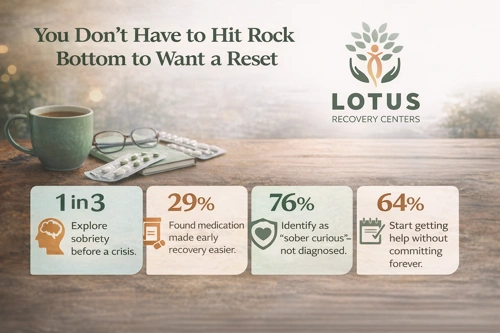
Sobriety Doesn’t Have to Start With Suffering
Think about how we treat other areas of health.
You don’t wait for a heart attack to start exercising.
You don’t wait until your teeth fall out to go to the dentist.
And you don’t have to wait until you’re in crisis to try sobriety.
In fact, getting curious before things get urgent is one of the healthiest, most emotionally intelligent things you can do.
That’s where support matters. Because white-knuckling your way through it alone rarely works—and it doesn’t have to be your only option.
Why Medication Can Make the First Weeks Easier
Let’s talk about the part people rarely say out loud:
The idea of stopping can be terrifying.
Not because you can’t live without it—but because you’re scared of what happens when you try. Cravings. Withdrawal. Anxiety. That emotional edge you’ve been numbing for years, suddenly back in full force.
That’s where medication comes in.
We work with FDA-approved medications that help:
- Reduce or eliminate cravings
- Lessen withdrawal symptoms
- Support brain chemistry as it rebalances
- Provide emotional stability so you can focus on healing
This isn’t a magic pill. But for many people, it’s the difference between lasting change and “I tried but couldn’t make it stick.”
It’s not about making sobriety easy. It’s about making it possible—especially in the beginning.
You Can Explore Without a Forever Commitment
Here’s something most people don’t realize:
Trying sobriety doesn’t mean you’re locking in a lifelong identity.
You’re allowed to:
- Try 30 days and see how you feel
- Use medication for a few months and then taper
- Change your mind along the way
Some people stay on medication long-term. Others use it as a bridge during high-risk times. Some move in and out of structured care as life shifts.
What matters isn’t the duration—it’s the support. You don’t have to promise forever. You just have to get honest about right now.
You Don’t Have to Go Cold Turkey
The all-or-nothing myth? It’s outdated—and often harmful.
At Lotus Recovery Centers, we support people in progress, not perfection. That means we meet you where you are.
Some of our clients taper gradually. Some stop completely with support. Others build structured plans that work with their responsibilities and emotional capacity.
Medication-assisted approaches allow flexibility. Your care is shaped around your needs, your body, your pace.
It’s not about willpower. It’s about finding what actually works—for you.
You’re Still You (Actually, You Might Finally Feel More Like You)
One concern that comes up a lot:
“What if I lose myself in sobriety?”
If drinking or using has been tied to your creativity, your social life, your identity—it’s normal to fear that removing it will remove you.
But here’s what we hear from clients again and again:
- “I actually feel more like myself now.”
- “I laugh more now, not less.”
- “I thought I’d be boring without drinking. Turns out, I’m just less anxious.”
The substances didn’t give you those parts. They covered them. You still have access to everything that matters—you’re just clearing the fog that’s been in the way.
You Don’t Have to Explain Yourself
You might not want to walk into a meeting. You might not be ready to tell your friends. You might not want to put a label on what you’re doing at all.
That’s okay.
You can explore sobriety quietly, privately, and on your own terms. Whether you choose group support, one-on-one care, or a low-profile medical approach, your reasons are your own.
There’s no script you have to follow to feel better.
If You’re in Delaware, Care Is Closer Than You Think
Whether you’re quietly searching from your phone or ready to talk to someone today, our team offers low-barrier care in Delaware that makes exploring sobriety feel possible—not overwhelming.
We don’t believe in shame-based care. We believe in second chances, soft starts, and small wins.
Wherever you are on the spectrum—from curious to committed—you’re welcome here.
Frequently Asked Questions (FAQ)
Do I have to stop drinking or using completely?
Not necessarily. Some clients begin with reduction goals or structured moderation plans. Others choose full sobriety. We’ll support you either way—with compassion and clarity.
Is medication just a crutch?
No. Medication can be a powerful tool in supporting real neurological healing and reducing relapse risk. It’s not a shortcut—it’s a strategy.
Will I have to do group therapy?
Only if you want to. Many clients start with medical support or individual sessions. Others find group work helpful later. We personalize your care based on what feels right to you.
How long will I need medication?
That depends on your goals and your response. Some people use it for a few months. Others longer. We reassess regularly and make adjustments together.
What if I’m not sure I belong in treatment?
Most people feel that way at first. Especially if they’re still “functioning.” But if you’re asking these questions, something inside you wants change. That’s reason enough to reach out.
You Don’t Need to Hit Bottom to Reach Out
You don’t have to call it addiction. You don’t have to swear off everything forever. You don’t need a label or a dramatic story.
You just have to want something more than fog and fatigue. You just have to want your life back—not because it’s broken, but because you’re done feeling less than fully alive.
Call 833-922-1615 to learn more about our medication-assisted treatment in Delaware.
Start small. Start curious. Just start.