

I didn’t lose everything.
I didn’t wake up in a jail cell. I didn’t crash my car or ruin Thanksgiving. I didn’t even miss a day of work. By all accounts, I was doing fine—killing it, even. But behind the productivity and the smiles was a second life that no one saw.
And it was exhausting.
What finally got me into recovery wasn’t a dramatic crash. It was a quiet collapse. The kind that doesn’t make headlines, just slowly erodes your peace. I wasn’t “sick enough” to need inpatient treatment, or so I thought. But I was sick of feeling like I was living two lives. That’s when someone mentioned an intensive outpatient program.
I didn’t know it then, but that conversation saved me.
It Looked Like I Had It All Together
On paper, I was thriving. I had a stable career, a social life, a partner who loved me. I went to the gym. I paid my taxes. I replied to emails on time.
But none of that tells you how I felt when I finally came home at night—buzzing with anxiety, desperate to drink it down. My coping mechanisms were polished. I’d tell myself it was just “a couple drinks to unwind” or “well-earned stress relief.” But deep down, I knew. I wasn’t drinking to relax. I was drinking to disappear.
I knew how to hide. I knew how to fake fine. And for a while, that was enough.
Until it wasn’t.
High-Functioning Doesn’t Mean You’re Not Hurting
Let’s get this straight: being high-functioning just means you’re good at hiding pain. It doesn’t mean you’re okay. It doesn’t mean you’re healthy. It means you’re managing—and sometimes that management becomes its own kind of hell.
It’s the endless juggling. The rehearsed smiles. The morning-after self-negotiation: “Okay, just take it easy tonight, you’ve got an early meeting tomorrow.” And then doing it all over again.
There’s no medal for suffering in silence. And no prize for pretending longer than necessary.
IOP Was Built for People Like Me—And Maybe You
When I finally looked into the intensive outpatient program at Lotus Recovery Centers, I was surprised at how normal it felt. It wasn’t boot camp. It wasn’t lock-down. It wasn’t some clinical version of punishment.
It was space—structured space—to finally be honest. To learn. To talk. To figure out what the hell was really going on beneath the surface.
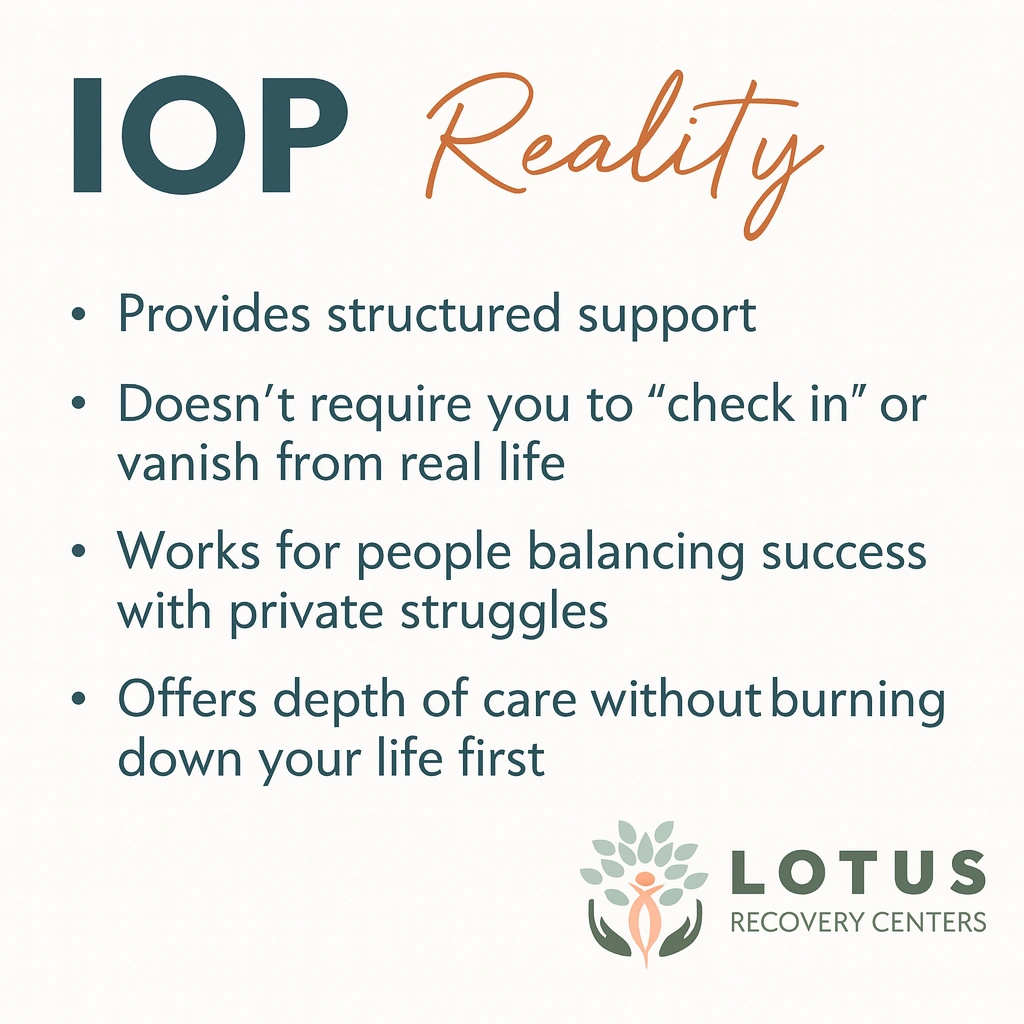
I went three nights a week. I didn’t have to quit my job. I didn’t have to vanish from my life. That was huge. The program didn’t just accommodate my life—it fit into it. Like a missing piece I didn’t know I was looking for.
I Thought I Was “Too Smart” for This—But I Was Just Too Afraid
Let me be blunt: my ego almost killed me.
I had a million reasons why I didn’t need help. “I’m not that bad.” “I can stop anytime.” “I just need a break, a vacation, a better schedule.” That’s fear talking in a fancy accent.
What IOP helped me realize was that I didn’t need a crash to justify care. I just needed to be honest with myself. That’s scarier than it sounds—especially when you’ve built your identity on keeping it together.
But the truth? I wasn’t keeping it together. I was just keeping it hidden.
Group Therapy Wasn’t Awkward—It Was a Relief
If the idea of sitting in a room and telling strangers your secrets sounds awful… same. But what actually happened? I found people who got it. People who’d been walking around with the same double life, the same shame, the same pressure.
It was the first time in a long time I didn’t feel crazy.
We didn’t wallow. We worked. We learned how to feel things instead of drink them. How to sit in discomfort without self-destructing. And the therapists? They weren’t robots. They were real people who asked the right questions and gave us space to be real.
You Don’t Have to Shatter Your Life to Start Changing It
That was one of the biggest myths I had to let go of—that recovery only comes after destruction. That you have to lose everything before you earn the right to want more.
That’s just not true.
You can start before it all falls apart. You can get help while you’re still functioning. You can recover without disappearing.
If you’re in Wilmington, DE—or even looking for an intensive outpatient program in Prices Corner, Delaware—you don’t have to wait until your life is unrecognizable. You can start where you are. Right now.
IOP Didn’t Fix Me—It Taught Me to Show Up for Myself
Recovery isn’t about becoming a different person. It’s about coming back to yourself. And that’s what IOP gave me: space to unlearn the performance, the people-pleasing, the perfectionism.
It didn’t feel like a punishment. It felt like a return.
And over time, the double life dissolved. The secrecy lost its grip. The pressure lifted. Not overnight—but step by step, session by session.
FAQs About Intensive Outpatient Programs (IOPs)
What is an intensive outpatient program (IOP)?
IOP is a structured treatment program that combines therapy, recovery support, and life skills without requiring you to live on-site. It’s ideal for people who need more than weekly therapy but aren’t in crisis or don’t need inpatient care.
How many days a week is IOP?
Most programs run 3–5 days a week, typically in 2–3 hour sessions. At Lotus Recovery Centers in Wilmington, DE, evening options are available to fit around work and family schedules.
Do I have to stop working to go to IOP?
Not at all. In fact, IOP is designed for people who are still working or attending school. It’s built to support your real life, not remove you from it.
Can I still participate if I’m not sober yet?
Yes. You don’t have to be perfectly sober to begin IOP. In many cases, it can help stabilize your relationship with substances while giving you tools to change at your own pace.
Is it confidential?
Absolutely. Participation in IOP is protected under HIPAA. No one has to know unless you choose to share it.
How do I know if IOP is right for me?
If you’ve ever thought, “I’m not doing great, but I can’t stop everything to get help,” then IOP might be for you. It’s for people who are struggling quietly and want to take control before things spiral.
You Don’t Need to Hit Bottom to Rise
If you’re managing a double life—successful on the outside, but spinning out internally—you’re not alone. You’re not broken. And you’re not too late.
Call (833)922-1615 to learn more about our intensive outpatient program services in Wilmington, DE.
Stop surviving your life. Start living it.