

I remember searching the same question over and over.
Not because I couldn’t find answers.
Because I was looking for reassurance hidden inside the answer.
I wanted someone to tell me exactly how many hours it would take. Exactly how many days I would feel miserable. Exactly when I would start feeling like myself again.
Mostly, I wanted proof that the suffering had an ending.
If you’re searching for answers right now, you might be in that same place.
You may be wondering what tomorrow will feel like. Or whether you’ll make it through the week. Or whether the discomfort is even worth it.
And if you’re anything like I was, there might be another fear underneath all of that.
Not just fear of withdrawal.
Fear of who you’ll be afterward.
Before we go any further, I want you to know this: many people who are now living meaningful, healthy lives once sat exactly where you’re sitting. They were scared. They were uncertain. They weren’t convinced they could do it.
Yet somehow, one day at a time, they got through it.
If you’re exploring options like a medication assisted treatment program, you’re already doing something important. You’re allowing yourself to imagine a future beyond what you’re experiencing right now.
The Question Behind the Question
When people search how long withdrawal lasts day by day, they’re usually asking for more than a timeline.
They’re asking:
“How much longer do I have to be afraid?”
“How bad will it get?”
“Will I survive this?”
“Will it ever stop?”
Those questions are deeply human.
Nobody willingly walks toward pain.
We want to know what we’re facing.
We want certainty before we take a risk.
But recovery rarely begins with certainty.
It usually begins with hope that is smaller than fear.
A tiny voice that says:
“Maybe life could be different.”
At first, that’s enough.
The First Day: Everything Feels Bigger
The first day often feels like standing at the base of a mountain.
You look up.
You see the climb.
You can’t see the other side.
And your mind immediately starts calculating whether it’s worth attempting.
For many people, anxiety becomes one of the biggest challenges during this stage.
The anticipation can be overwhelming.
Every sensation gets analyzed.
Every hour feels longer than normal.
You may find yourself wondering if you’ve made the right decision.
That doesn’t mean you’ve made the wrong one.
It means you’re human.
Fear has a way of convincing us that discomfort is permanent.
It isn’t.
The first day often involves more uncertainty than clarity.
More questions than answers.
That’s normal.
Days Two and Three: The Days People Fear Most
For many people, the second and third days feel like the hardest stretch.
Physical symptoms can become more intense.
Sleep may be difficult.
Restlessness can make it hard to sit still.
You may feel frustrated, exhausted, and emotionally drained all at once.
What surprised me most wasn’t the physical discomfort.
It was how emotional everything felt.
A commercial could make me tear up.
A random memory could send me spiraling.
A simple inconvenience felt enormous.
At the time, I thought something was wrong.
Now I understand what was happening.
My brain and body were adjusting.
Emotions that had been buried started rising to the surface.
Not because I was broken.
Because I was healing.
Healing isn’t always gentle.
Sometimes it looks messy before it looks better.
Why Creative People Often Struggle Differently
This is the part nobody explained to me.
Many people who identify as creative, passionate, artistic, charismatic, or emotionally intense often carry a unique fear into recovery.
We don’t just fear discomfort.
We fear becoming ordinary.
We worry that sobriety will flatten us.
That it will erase the parts of us that make us interesting.
Maybe substances felt connected to your creativity.
Your confidence.
Your social life.
Your ability to perform.
Your ability to feel.
The thought of losing those things can be terrifying.
I know because I felt it too.
I honestly believed recovery would turn life black and white.
I pictured a smaller version of myself.
Less expressive.
Less inspired.
Less alive.
The reality was very different.
What I eventually discovered was that addiction had been shrinking my world far more than recovery ever would.
The Negotiation Phase
Around the most difficult days, something interesting tends to happen.
Your brain starts making deals.
Not dramatic deals.
Reasonable-sounding ones.
“Maybe I wasn’t that bad.”
“Maybe I can control it next time.”
“Maybe I should wait another month.”
“Maybe now isn’t the right time.”
Those thoughts can feel convincing because they’re designed to relieve discomfort.
The problem is that they’re usually focused on immediate relief rather than long-term freedom.
This is one reason support matters so much.
When you’re exhausted, scared, and overwhelmed, it’s difficult to trust your own perspective.
Having people around you who understand what you’re experiencing can make all the difference.
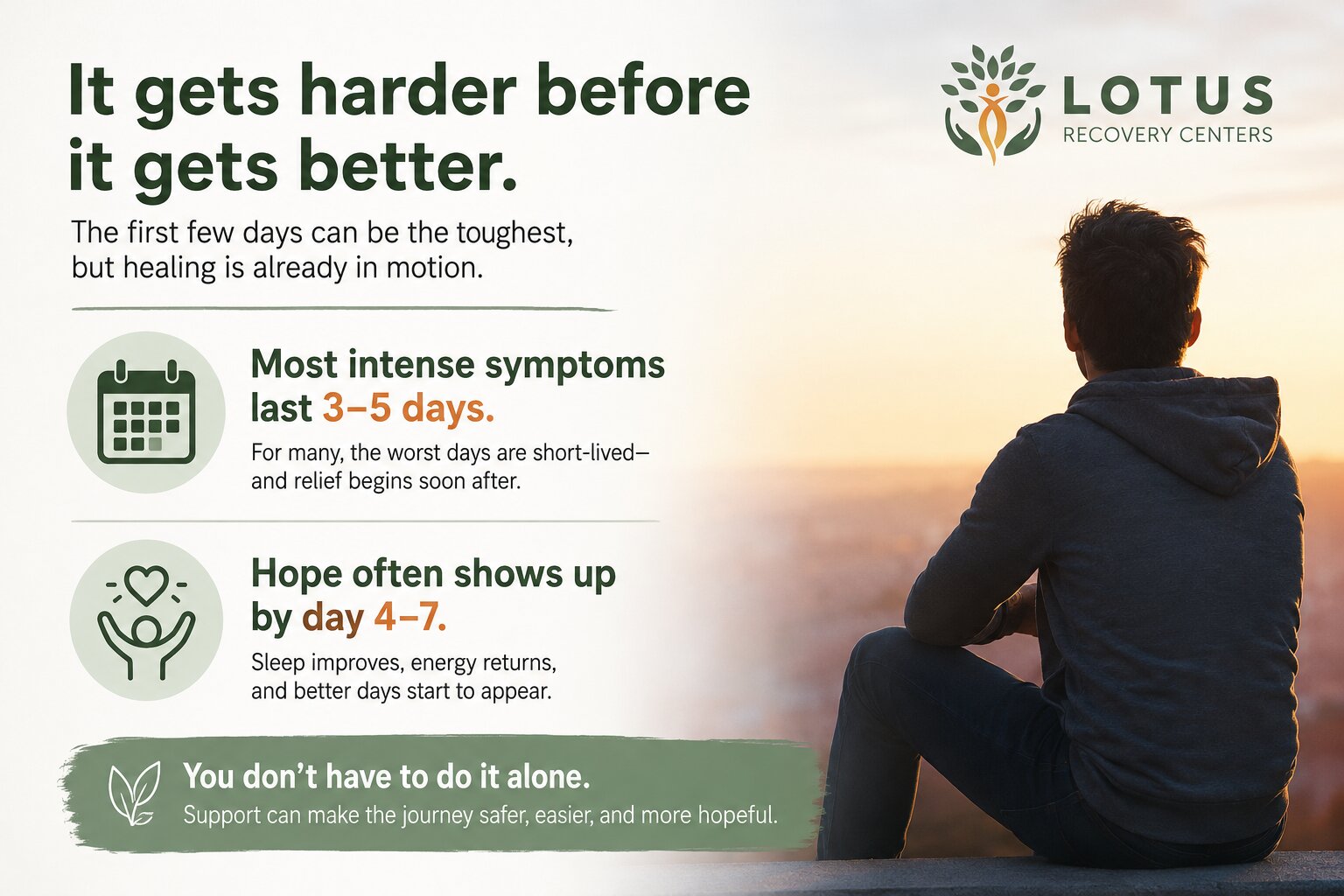
Days Four Through Seven: The Light Starts Showing Up
Many people expect a dramatic turning point.
A movie moment.
A sudden feeling of freedom.
Recovery usually doesn’t work that way.
Instead, it often arrives in small moments.
A full night’s sleep.
A genuine laugh.
An appetite returning.
A clear thought.
A quiet morning.
At first, these moments seem insignificant.
They’re not.
They’re evidence that healing is happening.
Think of recovery like watching winter slowly become spring.
You don’t wake up one morning and suddenly find everything green.
The changes happen gradually.
One small sign at a time.
Then one day you realize the landscape has changed.
Why Comparing Yourself to Others Can Make Things Harder
One of the biggest mistakes people make during early recovery is comparing their experience to someone else’s.
Everyone wants a timeline.
Everyone wants certainty.
Unfortunately, healing doesn’t follow a universal schedule.
Some people improve quickly.
Others take longer.
Neither experience means you’re succeeding or failing.
The goal isn’t to match someone else’s pace.
The goal is to keep moving forward.
Recovery is personal.
Your story won’t look exactly like anyone else’s.
That’s okay.
Looking Beyond the First Week
One reason people become discouraged is because they assume recovery is supposed to feel amazing immediately.
It often doesn’t.
The first week is not the destination.
It’s the beginning.
There may still be emotional ups and downs.
There may still be difficult days.
There may still be moments where you question yourself.
That’s not evidence that recovery isn’t working.
It’s evidence that recovery is real.
Real change takes time.
But it also creates possibilities that didn’t exist before.
Relationships begin to heal.
Goals begin to feel achievable again.
Creativity often returns in unexpected ways.
Confidence becomes something deeper than a temporary feeling.
You start building a life instead of simply surviving one.
The Future I Was Afraid Of Never Arrived
I spent years imagining what recovery would take away.
I rarely considered what it might give me.
I thought I’d lose excitement.
I thought I’d lose inspiration.
I thought I’d lose part of my identity.
Instead, I lost constant chaos.
I lost the fear of running out.
I lost the mental math that consumed so much energy.
I lost the feeling that my entire life revolved around avoiding discomfort.
What I gained was clarity.
Connection.
Peace.
Freedom.
Not perfect freedom.
Real freedom.
The kind that allows you to wake up and decide what matters rather than letting addiction decide for you.
Many people researching a fentanyl withdrawal timeline are standing at the edge of that possibility right now.
And while the first days may be difficult, they are not the whole story.
They’re only the beginning.
FAQ
How long do the hardest withdrawal symptoms usually last?
Many people find that the most intense physical symptoms occur during the first several days. The exact experience varies based on individual factors, but improvement often begins gradually rather than all at once.
Why does withdrawal feel different for different people?
Factors such as overall health, history of substance use, frequency of use, and available support can influence how withdrawal feels and how long symptoms persist.
Is it normal to feel anxious during withdrawal?
Yes. Anxiety is a common part of the process. The uncertainty of change, combined with physical symptoms, can make anxiety feel especially intense during early recovery.
Will withdrawal affect my emotions?
Many people experience mood changes, irritability, sadness, emotional sensitivity, or unexpected emotional reactions. This can be part of the body’s adjustment process.
Can medication-assisted treatment help?
Many individuals find that medication-assisted treatment provides valuable support during recovery. Treatment recommendations should always be discussed with qualified professionals who can assess individual needs.
Will recovery make me less creative?
Many people fear this, especially artists, musicians, writers, entrepreneurs, and highly expressive individuals. In reality, many discover that recovery creates more space for creativity because less energy is spent managing addiction.
What if I’ve tried to quit before and couldn’t?
Previous attempts don’t determine future outcomes. Many people who achieve lasting recovery experienced setbacks before finding a path and support system that worked for them.
When should someone seek professional help?
If withdrawal symptoms feel overwhelming or if you’re struggling to stop using on your own, professional support can provide guidance, safety, and treatment options tailored to your situation.
The Pain Is Real, But It Isn’t Permanent
If you’re reading this because you’re scared, I understand.
If you’re reading this because you’re trying to decide whether recovery is worth it, I understand that too.
The difficult days are real.
The fear is real.
The uncertainty is real.
But none of those things are permanent.
The person waiting on the other side of this process isn’t a watered-down version of you.
They aren’t less creative.
Less interesting.
Less alive.
They’re simply no longer carrying a weight that has become too heavy to hold.
If you’re looking for treatment options and support, you can learn more about care in Delaware.
Call (833)922-1615 or visit our medication assisted treatment MAT services to learn more about our programs, medication assisted treatment mat services in Prices Corner, DE.