

I hear this question more than almost any other.
Not always out loud—but it shows up in hesitation, in half-finished sentences, in the way people look at me and then look away.
“If I do this… will I still be me?”
If you’ve been relying on pain pills, it’s not just about the physical part anymore. It’s about how they’ve woven themselves into your identity—how you feel, how you express yourself, how you get through hard moments.
So when you start thinking about stopping—or even just getting help—it can feel like you’re being asked to trade yourself in for a different version.
If you’re exploring something like medication-supported recovery approaches, that fear can get louder:
What if I lose something I can’t get back?
Let’s slow that down together.
The Fear Makes Sense—Even If No One Has Said That to You Yet
A lot of people expect to be talked out of this fear.
But I won’t do that.
Because it’s not irrational.
If something has helped you:
- Feel more open
- Stay emotionally steady
- Access creativity or connection
- Get through days that felt too heavy otherwise
…then of course letting it go feels risky.
You’re not just stepping away from a substance.
You’re stepping away from a tool that, at some point, worked.
Even if it came with consequences.
Even if those consequences are catching up now.
That tension you feel?
That’s awareness, not weakness.
You’re Not Losing Yourself—You’re Losing the Filter
One of the most common surprises I see is this:
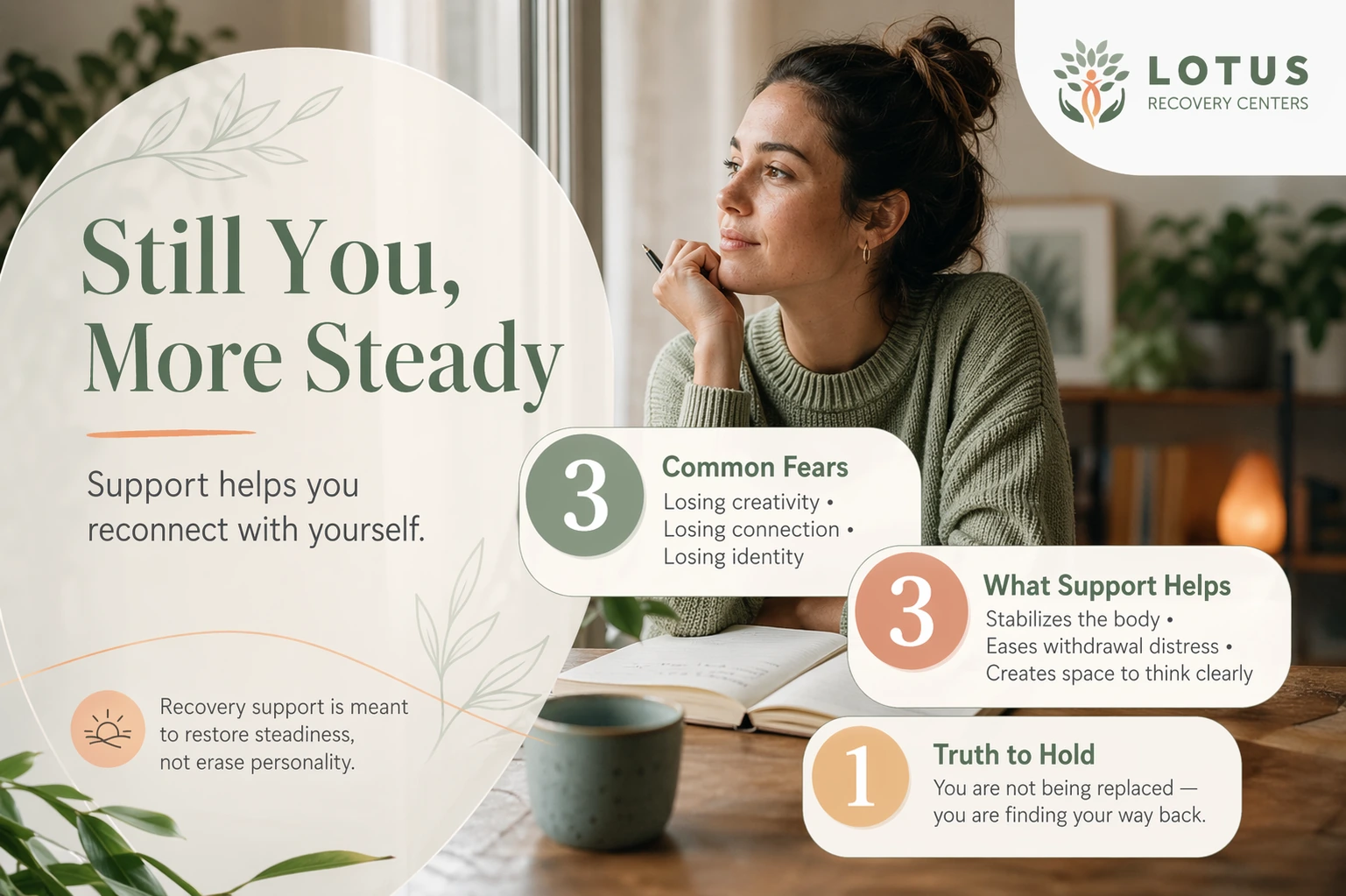
People expect to feel like someone else.
Instead, they start noticing pieces of themselves they hadn’t felt in a while.
Not all at once. Not dramatically.
But gradually.
It can look like:
- Laughing without needing anything first
- Feeling present in a conversation instead of slightly removed
- Experiencing emotion without it being either numbed or overwhelming
It’s not a transformation into a new identity.
It’s more like removing a layer that’s been sitting between you and your natural state.
Think of it like a fog that became so familiar, you forgot what clear air felt like.
Medication Doesn’t Replace You—It Supports Your Body
There’s a lot of misunderstanding here, and it creates unnecessary fear.
Medication isn’t meant to override your personality or flatten you out.
It’s meant to stabilize your system—especially if your body has become dependent in a way that makes stopping feel impossible.
If you’re waking up feeling sick without using, your body isn’t being dramatic. It’s reacting to a real shift in chemistry.
That’s where opioid withdrawal help becomes relevant—not as a way to avoid reality, but as a way to make the process safer and more manageable.
When your body isn’t in distress, something important happens:
You get space.
Space to think clearly.
Space to feel without panic.
Space to reconnect with yourself without being pulled back into a cycle just to feel okay.
The Version of You That Exists Without Constant Managing
Right now, a lot of your energy might go into staying balanced.
Not just emotionally—but physically.
- Timing your use
- Making sure you don’t feel sick
- Planning your day around staying functional
That’s not freedom.
That’s maintenance.
When people begin to step out of that pattern—with the right kind of support—they often notice something subtle but powerful:
They don’t have to think about it as much.
Their day isn’t built around managing symptoms.
They can just… exist.
And in that space, your actual personality—the one that isn’t shaped by needing something—has room to show up.
You Won’t Lose Your Depth—You’ll Gain Consistency
This is especially important if you see yourself as someone who feels deeply.
A lot of people worry that without substances, they’ll become flat or disconnected.
But what I tend to see is the opposite.
Instead of:
- High highs and low lows
- Intensity followed by crashes
People begin to experience:
- Steady emotions
- Reliable creativity
- Connection that doesn’t depend on being in a certain state
You don’t lose depth.
You lose the unpredictability that makes it hard to access that depth consistently.
The Adjustment Period Is Real—But It’s Not Permanent
I won’t pretend there isn’t a transition.
There is.
Moments where things feel unfamiliar.
Where your body is recalibrating.
Where you might wonder if you made the right choice.
That doesn’t mean you’ve lost yourself.
It means your system is learning a new way to function.
And with the right support, that adjustment becomes something you move through—not something that overwhelms you.
If you’re in or near Delaware, there are options for help in Delaware that are designed to support you through that transition—not rush it.
What People Say After They Get Through This Fear
I’ve had this conversation many times.
At the beginning, it sounds like:
“I don’t want to lose who I am.”
Later, it sounds more like:
“I didn’t realize how much of me was still there.”
That shift doesn’t come from being convinced.
It comes from experiencing it.
From realizing that what you were afraid of losing…
was never actually gone.
It was just harder to reach.
You Don’t Have to Decide Everything Right Now
There’s a lot of pressure that can come with this moment.
To be sure.
To be ready.
To commit fully.
You don’t have to do all of that today.
You can:
- Ask questions
- Learn what support looks like
- Take one step without mapping out the entire path
That’s enough.
FAQs: The Questions People Usually Ask (But Don’t Always Say Out Loud)
Will medication change my personality?
No—not in the way you’re probably imagining. The goal is not to alter who you are, but to help your body stabilize so you can function without distress. Most people feel more like themselves, not less.
What if I rely on substances to feel creative or expressive?
This is a common concern. What many people discover is that creativity doesn’t disappear—it becomes more consistent. You don’t have to depend on a specific state to access it.
Will I feel numb or emotionally flat?
Some adjustment can happen early on, but long-term numbness is not the goal. In fact, most people experience clearer, more balanced emotions once their system stabilizes.
How do I know if I need this kind of support?
If you’re waking up feeling sick without using, or if stopping feels physically overwhelming, that’s a sign your body may need support. You don’t have to figure that out alone.
What if I’m not ready to fully stop yet?
That’s okay. You don’t need to force a decision. Sometimes the first step is just understanding what your options are and what support could look like for you.
Is it normal to feel scared about losing my identity?
Yes. Very normal. It’s one of the most common fears—and one that deserves to be taken seriously, not dismissed.
You’re Still In There
This is the part I want you to hold onto.
You are not something that needs to be replaced.
You are not someone who has to disappear to get better.
You’re someone whose system adapted—and now needs support to come back into balance.
And that version of you?
The one you’re worried about losing?
It’s still there.
It hasn’t gone anywhere.
Call (833)922-1615 or visit our medication assisted treatment mat services in Wilmington, DE to learn more about your options.
You don’t have to trade yourself in to feel better.
You just need the right support to come back to yourself.