

There’s a version of this fear that doesn’t sound dramatic—but it’s powerful:
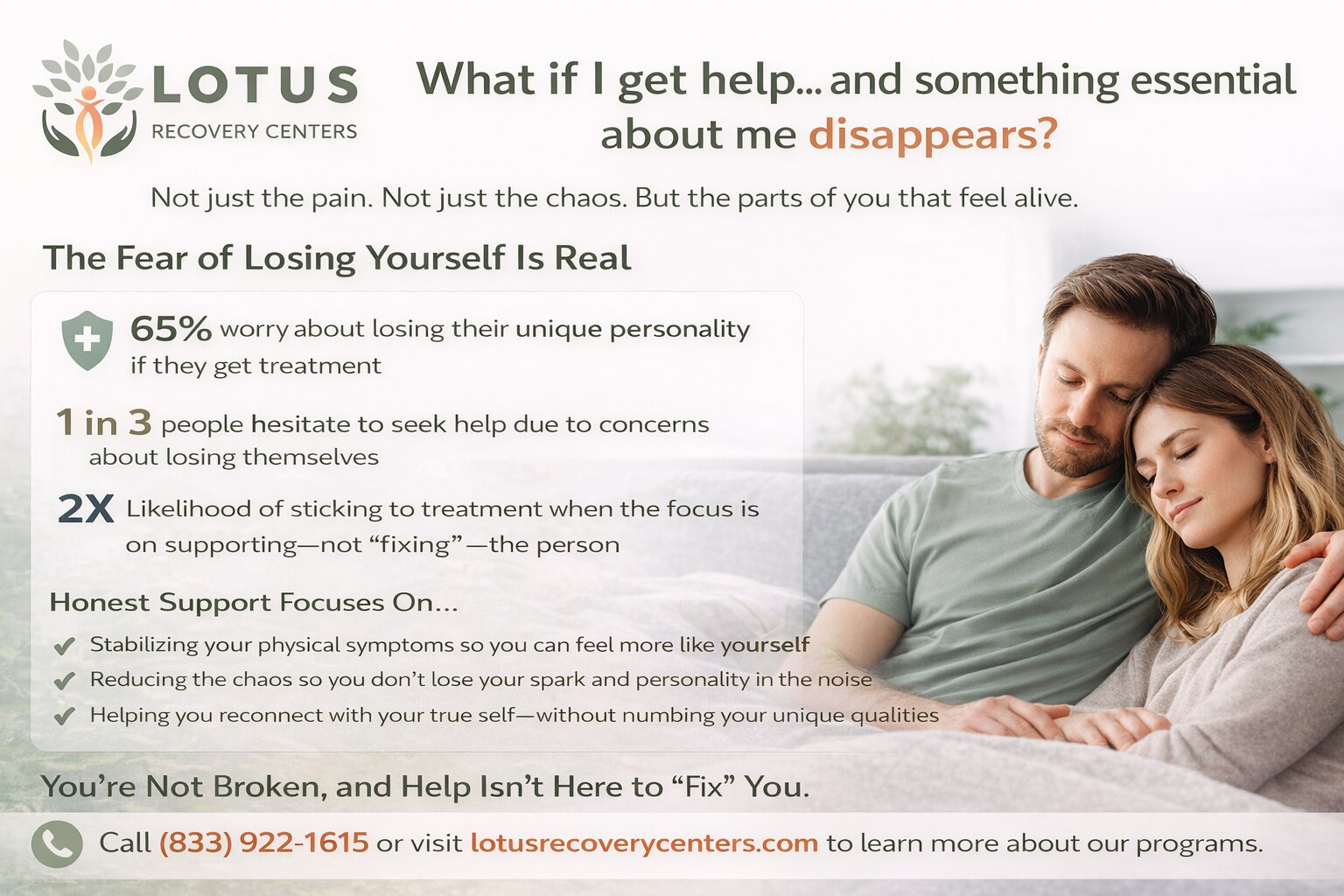
What if I get help… and something essential about me disappears?
Not just the pain. Not just the chaos.
But the parts of you that feel alive.
At Lotus Recovery Centers, we hear this more often than you’d think. Especially from people who feel deeply, think creatively, or have learned to rely on something external to access parts of themselves.
Many start by exploring medication assisted support with hesitation—not because they don’t want help, but because they don’t want to lose themselves in the process.
That fear deserves to be taken seriously.
You’re Not Broken—So We’re Not Trying to “Fix” You
Let’s be clear about something upfront:
You are not a problem we’re trying to correct.
You’re someone who adapted.
Maybe substances helped you feel more open, less anxious, more expressive, more connected. Maybe they helped you quiet something loud inside you. Maybe they helped you show up in a world that felt overwhelming.
That doesn’t make you broken. It makes you human.
So no—we’re not here to “fix” you.
We’re here to help you separate you from what’s been weighing you down.
The Fear Isn’t Irrational—It’s Protective
A lot of people carry this quiet belief:
“If I let go of this, I might lose the best parts of myself too.”
And honestly? That belief didn’t come from nowhere.
If you’ve ever felt:
- More confident after using
- More social, more open, more creative
- Less stuck in your own head
Then of course you’d question what life looks like without it.
This fear is protective. It’s trying to make sure you don’t lose access to something important.
But here’s the shift we gently offer:
What if those qualities don’t belong to the substance…
What if they belong to you?
What You’re Feeling Might Be You—Filtered Through Survival
There’s a difference between who you are and how you’ve learned to cope.
Substances can act like a filter:
- Turning the volume up on confidence
- Blurring out anxiety
- Fast-tracking connection
- Dulling emotional pain
But filters aren’t the same as identity.
They change how things appear—but not what’s underneath.
And over time, that filter can get heavier. Less optional. Less helpful. More controlling.
We’ve seen many people realize something surprising in recovery:
They didn’t lose themselves.
They just hadn’t met themselves without the interference in a long time.
A Story We See More Often Than You Think
“I thought I’d become boring. That I’d lose my edge. But what actually happened… I started remembering things. Conversations. Ideas. I could sit with myself without needing something to get through it.”
— MAT Client
That shift doesn’t happen all at once.
At first, it can feel unfamiliar. Even uncomfortable.
But slowly, something steadier begins to show up. Not louder. Not forced. Just… clearer.
Medication Isn’t Meant to Flatten You
Let’s talk about one of the biggest concerns people have.
Medication can feel like a threat to identity. Like it might make you numb, disconnected, or not fully you.
But when used thoughtfully, medication assisted care is not about sedation—it’s about stability.
It can:
- Reduce the intensity of cravings
- Ease physical withdrawal
- Create space between impulse and action
For individuals navigating things like fentanyl addiction treatment Wilmington, that physical intensity can be overwhelming enough to drown out everything else. Medication can help quiet that storm just enough for you to think, feel, and choose again.
It’s not taking something away from you.
It’s helping you get your footing back.
You Don’t Have to Choose Between Depth and Stability
There’s a myth that keeps people stuck:
If I get stable, I’ll lose my depth.
But depth doesn’t come from chaos.
It comes from being able to stay present with your experience.
Imagine:
- Feeling emotions without being consumed by them
- Expressing yourself without needing a substance to unlock it
- Connecting with people without second-guessing everything later
That’s not a loss of identity.
That’s access.
Coming Back to Yourself Is a Process—Not a Switch
There isn’t a moment where everything clicks and you suddenly feel like “yourself again.”
It’s slower than that.
You might:
- Feel unsure at first
- Miss certain feelings or routines
- Question whether this is “working”
That’s part of the process—not a sign you’re doing it wrong.
Over time, things begin to shift:
You start recognizing your thoughts more clearly.
You feel moments of calm that aren’t forced.
You laugh—and it feels real.
That’s not something new being created.
That’s something old being uncovered.
You’re Allowed to Be Skeptical
You don’t have to fully believe this right now.
You don’t have to feel ready, confident, or certain.
It’s okay if part of you is still thinking:
“Yeah, but what if it’s not like that for me?”
That part is welcome too.
All we ask is that you stay curious enough to explore what’s possible.
If you’re looking at treatment options in Delaware, you don’t need to have it all figured out before reaching out. You just need a small willingness to consider that things could feel different.
You’re Still In There
This is the part we don’t want you to forget:
You are still you.
Not the version shaped by pressure or pain or survival—but the one underneath all of it.
The one who:
- Thinks in a way that’s uniquely yours
- Feels things deeply
- Has something real to offer
Treatment doesn’t take that away.
It helps you get back to it—without needing something external to access it.
Frequently Asked Questions
Will I feel like a different person in recovery?
You might feel different at first—but not in the way you’re fearing. Most people don’t lose themselves; they begin to feel more grounded, clear, and emotionally present over time.
Does medication change your personality?
When used appropriately, it’s not meant to change who you are. It’s designed to stabilize physical and mental symptoms so you can function and reconnect with yourself more clearly.
What if substances help me feel creative or social?
That’s a real concern. But many people discover those qualities were always theirs—they just relied on substances to access them. Recovery focuses on helping you access them naturally.
Is it normal to be afraid of losing your identity?
Yes. This is one of the most common fears, especially for people who feel deeply or identify strongly with how they show up socially or creatively.
How long does it take to feel like yourself again?
It varies. Some people notice small shifts quickly, while deeper clarity builds over time. It’s a gradual return, not an instant change.
What if I try and it doesn’t feel right?
That’s okay. Treatment is a process, and it can be adjusted. You’re not locked into one path—you can explore what works for you.
You don’t have to trade who you are for support. You don’t have to become someone else to get better.
Call (833)922-1615 or visit our medication assisted treatment mat services in Wilmington, DE to learn more about our programs.